
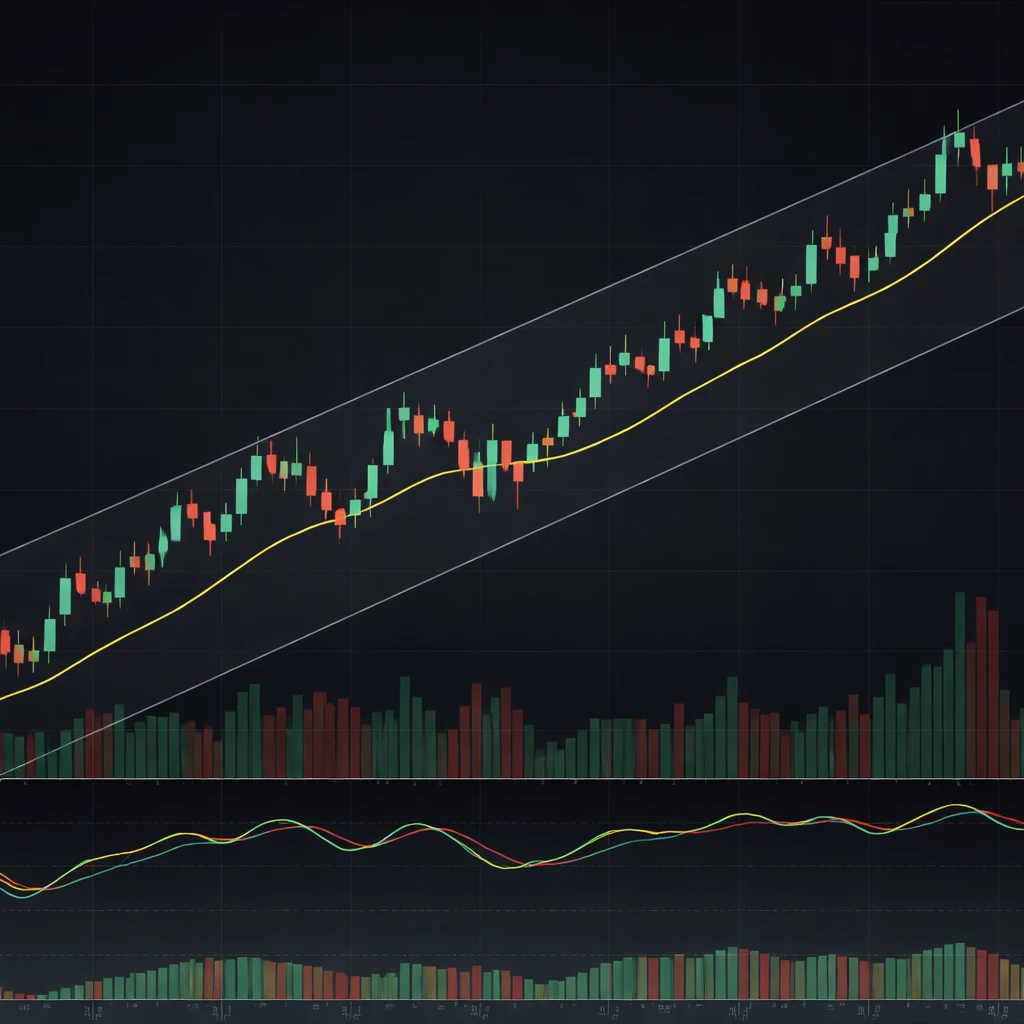
Overview
Trend strength and duration describe two complementary qualities of directional price movement. Strength summarizes how forcefully price advances or declines. Duration summarizes how long that directional bias persists before a structural change or a sustained consolidation interrupts it. Together they provide context for interpreting price behavior, locating a market within a larger cycle, and reading the interaction between momentum, volatility, and market structure.
Technical analysis treats price as a sequence of swings that form structures such as higher highs and higher lows in an uptrend, or lower highs and lower lows in a downtrend. Within that structure, some trends move rapidly with shallow counter moves, while others crawl forward with frequent overlap. Some trends exhaust quickly. Others persist across many sessions or weeks. Distinguishing between a strong, short trend and a moderate, long trend matters because each conveys different information about participation, conviction, and the likelihood of consolidation.
Defining Trend Strength
Trend strength refers to the intensity and quality of directional movement. It is not a single number. Instead it is a composite impression derived from several price attributes that often move together:
- Speed: the rate of change in price per unit of time. A sharp sequence of large-bodied candles indicates rapid progress.
- Consistency: the regularity of higher highs and higher lows in an uptrend, or lower highs and lower lows in a downtrend, with limited overlap between consecutive bars.
- Pullback depth: the typical size of countertrend moves relative to the preceding impulse leg. Shallow pullbacks suggest strong pressure in the trend direction.
- Breadth and participation: in indexes or sectors, how many constituents move with the trend. Broad participation often accompanies stronger moves.
- Volatility character: whether volatility expands in the direction of the trend or remains contained. Efficient trends often show directional expansion on impulses and contraction on pauses.
These elements can be observed directly on charts. Strength is visible in the slope of swing advances, the size and clustering of candle bodies, the presence of gaps that hold, and the alignment of moving averages that tilt in the trend direction. Momentum oscillators are commonly used to summarize the rate of change component of strength, though the chart itself usually communicates the same information when read carefully.
Defining Trend Duration
Trend duration is the time dimension of a directional phase. It asks how long the market maintains a consistent sequence of swings before a structural change, such as a break of the prior swing high in a downtrend or a break of the prior swing low in an uptrend, interrupts it. Duration can be measured in bars, days, weeks, or months. It can also be described qualitatively by the number of complete swing cycles within the trend.
Several features influence duration:
- Regime stability: persistent macro or micro catalysts often lengthen a trend phase by providing ongoing reasons for one side to dominate.
- Structural reinforcement: recurring respect of trendlines or channels, and repeated support or resistance handoff, tend to extend moves.
- Energy depletion: trends that move too far too fast often shorten their own lifespan as participants take profits and late entrants face adverse variance.
- Timeframe interaction: a trend that aligns across multiple timeframes typically lasts longer than one that conflicts with higher level structure.
Duration is not the same as distance traveled. A market can rise a small amount over a long period or move far in a short burst. Reading duration helps frame expectations about how mature a trend may be and how likely it is to stall, consolidate, or transition.
How Strength Appears on Charts
Strength leaves a visible footprint. Several recurring chart features are associated with a strong trend:
- Steep slope with orderly pullbacks: impulse legs are larger than corrective legs, candle bodies are prominent, and pullbacks are short in time and depth.
- Limited overlap: consecutive bars do not overlap much. In uptrends, closes cluster near daily highs. In downtrends, closes often occur near lows.
- Holding gaps: gaps that remain open for several sessions reflect sustained demand or supply.
- Moving average alignment: shorter averages reside above longer ones in an uptrend, or below in a downtrend, with noticeable tilt. The slope communicates the rate of change.
- Momentum confirmation: rate-of-change measures or oscillators reach and sustain elevated readings during impulses, then reset modestly on pauses without breaking prior reference levels.
- Volume or participation cues: in many markets, volume expands on impulses and contracts on pullbacks. In index contexts, more constituents moving with the trend supports the read of strength.
None of these features guarantees continuation. They simply communicate that, so far, price advances or declines have been effective and sustained. Observing any one attribute in isolation is less informative than assessing the cluster of features present.
How Duration Appears on Charts
Duration is visible in the count of bars and swings that respect the trend’s structure. Common signs include:
- Series longevity: a sequence of higher highs and higher lows persists across many swings without a decisive break in the pattern.
- Time spent near extremes: price spends a significant portion of time near the upper region of the range in an uptrend or near the lower region in a downtrend.
- Rhythmic cycles: the market forms repetitive impulse-pullback patterns with relatively stable timing between swing highs and lows.
- Channel maintenance: price respects a rising or falling channel for an extended period, with reactions near boundaries followed by reversion toward the channel median.
Long duration does not mean linear movement. Durable trends usually include consolidations, flags, and pauses that reset momentum without breaking structure. Reading duration focuses on whether those pauses preserve the sequence of swing points and whether time is predominantly spent moving with or against the direction of the trend.
Market Structure and the Quality of a Trend
Market structure provides the frame for reading both strength and duration. An uptrend is organized as stair steps of higher highs and higher lows. A downtrend is organized as lower highs and lower lows. Strength speaks to the steepness and cleanliness of each stair step. Duration speaks to how many stair steps occur before the staircase changes direction.
Several structural elements add nuance:
- Swing symmetry: the relative magnitude of impulse legs compared to corrections. In a strong uptrend, impulses are longer in price and often shorter in time than pullbacks.
- Pullback retracement: the fraction of the prior leg retraced during a pullback. Shallow retracements suggest firm commitment. Deep retracements that still hold the prior low can indicate a trend under stress but not yet broken.
- Break of structure: a decisive close below the prior swing low in an uptrend or above the prior swing high in a downtrend signals an interruption in the pattern. This relates to duration because it marks the endpoint of the prior trend phase.
- Overlap and congestion: increased overlap between bars and frequent returns to the same price region reduce the read of strength. If congestion persists, duration may continue nominally, but the quality of the trend deteriorates.
Why Analysts Pay Attention
Understanding strength and duration improves the interpretation of price behavior in several ways:
- Context setting: identifying whether a move is forceful and young, or moderate and mature, helps frame expectations for volatility, potential consolidation, and the range of plausible path shapes.
- Regime identification: strong, persistent trends often coincide with distinct market regimes. Recognizing regime characteristics can improve the reading of subsequent signals.
- Risk characterization: the depth and frequency of pullbacks inform the typical adverse variance a trend has produced, without implying future results.
- Timeframe alignment: seeing how a trend on a lower timeframe fits within a higher timeframe movement can clarify whether local strength is operating with or against a larger structural backdrop.
Practical Chart-Based Examples
Example 1: A Developing Uptrend
Suppose a stock advances from 50 to 80 over six weeks. The chart shows a series of higher highs and higher lows, with three distinct impulse legs. The first impulse moves from 50 to 60 in five sessions, followed by a pullback to 58 over two sessions. The second impulse advances from 58 to 70 across seven sessions, followed by a pullback to 67 across three sessions. The third impulse reaches from 67 to 80 over eight sessions.
Several observations illustrate strength:
- Impulse legs are larger than pullbacks in both price and speed.
- Candle bodies on up days are longer than those on down days, and many closes are near the daily highs.
- A short-term moving average tilts upward and resides above a medium-term average. Price largely holds above the short-term average during the run.
- When pullbacks occur, they retrace a modest portion of the prior move and stall above prior swing lows.
Now consider duration. The uptrend has persisted across three leg-pullback cycles and roughly six weeks. Time is mostly spent either moving higher or consolidating near the highs rather than returning to the base. That balance of time at higher prices, combined with intact structure, describes a durable phase rather than a single sharp spike.
Example 2: A Prolonged Downtrend With Aging Characteristics
Consider an index that has declined from 4,500 to 3,600 over four months. The early phase shows strong strength features: large-bodied down days, gaps that do not fill, and swift rejection of attempts to rally. Over time, however, the character changes. Pullbacks upward become deeper and last longer, overlapping prior candle ranges. Momentum readings fail to make new extremes on fresh lows. Volume begins to concentrate during rallies as mean reversion attempts gather interest, while some down days show less follow-through.
The structure still records lower highs and lower lows, so the downtrend’s duration continues in a formal sense. Yet the quality of the trend has weakened. The rate of change is slower, overlap is higher, and the market spends more time oscillating in mid-range than it did in the early phase. Such aging characteristics indicate a decline that has persisted but may be losing strength even before a definitive structural break occurs.
Reading Strength Through Multiple Lenses
Because no single measure defines strength, analysts often triangulate using several lenses that echo the same message:
- Price-only observations: compare the size of impulse legs to pullbacks, count how many closes occur near bar extremes, and observe whether gaps hold.
- Trendlines and channels: a well-respected channel with minor violations and swift rejections suggests orderly strength.
- Moving average slope and separation: rising averages with widening separation reflect acceleration, while flattening slopes and shrinking separation suggest deceleration.
- Momentum proxies: higher momentum highs aligned with higher price highs reflect supportive strength. Diminishing momentum on new price highs, a form of divergence, highlights potential loss of force.
- Volatility structure: directional expansion during impulses accompanied by contraction during pauses signals efficient trend mechanics. Whipsaw within narrow ranges reduces the read of strength.
These lenses are most informative when they align. If they conflict, it may indicate transition, noise, or a regime shift that requires more observation before drawing conclusions about the underlying state.
Time and the Maturation of Trends
Duration invites questions about aging. Trends can appear strong and still be late in their lifespan. Several time-related characteristics often appear as trends mature:
- Longer pauses between impulses: consolidations lengthen as the market needs more time to absorb prior movement.
- Increasing overlap: price revisits the same zones more frequently. Progress comes in fits rather than clean stair steps.
- Exhaustion spurts: after a lengthy grind, a final rapid acceleration can occur, creating a parabolic segment. Such moves may travel far but often shorten remaining duration because they attract profit-taking and two-sided trade.
- More two-way volatility: both impulse and pullback legs expand, with swings becoming similar in size. Symmetry between up and down legs reduces directional dominance.
Maturation does not imply immediate reversal. It suggests a trend that has consumed time and distance and may begin to alternate between phases of travel and rest more frequently than before.
Multiple Timeframe Context
Trend strength and duration are relative to timeframe. A strong trend on a 60-minute chart may be a minor swing within a larger weekly consolidation. Conversely, a modest daily trend might sit within a powerful multi-quarter secular movement.
When comparing timeframes, several observations help keep perspective:
- Nesting of swings: lower timeframe impulses often form the substructure of higher timeframe candles. A cluster of strong lower timeframe legs may produce a single large daily candle.
- Dominant direction: if higher timeframe structure is trending, lower timeframe pullbacks may be shorter and less persistent. If higher timeframe structure is range-bound, apparent lower timeframe strength may fade quickly.
- Duration alignment: a trend with long duration on a higher timeframe can absorb multiple countertrend phases on lower timeframes without losing its identity.
Placing a local read of strength within the higher timeframe narrative reduces misinterpretation and helps distinguish structural breaks from routine noise.
Volatility, Liquidity, and the Look of Strength
Market microstructure shapes how strength appears. In highly liquid instruments, strong trends can look smooth, with narrow bid-ask spreads and minimal gaps. In thinner markets, strong trends may display ragged candles and frequent gaps despite real directional pressure. Volatility regimes also matter. In a high volatility environment, a strong trend may include large countertrend swings that would appear abnormal in a low volatility regime. Adjusting expectations to the instrument and regime avoids misclassifying benign retracements as structural damage.
Distinguishing Healthy Pauses From Weakness
Not all slowdowns indicate deterioration. Healthy pauses typically show the following:
- Orderly consolidation: a drift sideways or a narrow channel against the trend with declining volatility and volume.
- Respect for structure: pullbacks that stall above the prior swing low in an uptrend or below the prior swing high in a downtrend.
- Selective participation: breadth may narrow temporarily while leadership persists, then broaden on the next impulse.
Weakness is more likely when pullbacks deepen, volatility expands broadly in both directions, or when the sequence of swing highs or lows breaks decisively. The distinction depends on both price geometry and time spent correcting relative to time spent advancing.
Simple, Non-Formula Ways to Gauge Strength and Duration
Analysts often prefer straightforward visual yardsticks that do not require complex calculations:
- Leg-to-pullback ratio: compare the size of the last impulse to the size of the last pullback. A ratio greater than 1 indicates impulses are outpacing corrections.
- Time-in-trend vs time-in-pullback: count bars spent advancing versus bars spent correcting. Strong phases allocate more time to progress than to retracement.
- Closes above or below a reference average: count how many recent bars closed on the trend side of a reference moving average.
- Channel interactions: note whether price rides the channel median or hugs the boundary. Frequent tags of the trend-side boundary with only shallow rejections support a strong read.
- Swing consistency: record how many consecutive higher lows or lower highs have formed without a break.
These simple checks reinforce the broader narrative that the chart is already telling. They help avoid overreliance on any single indicator.
Common Pitfalls in Interpreting Strength and Duration
Several mistakes recur when reading these concepts:
- Ignoring the time axis: distance traveled can seem impressive, but if it took many bars and featured heavy overlap, strength may be only moderate.
- Scale distortions: linear versus logarithmic scales change the visual slope for long histories. Comparing slopes across long time spans requires consistent scaling.
- Single-indicator dependence: relying on one oscillator or one moving average can mislead when regime conditions change.
- Confusing exhaustion with acceleration: late-cycle spurts that look powerful can also deplete participation, reducing subsequent duration.
- Neglecting breadth: in indexes, a trend carried by a handful of constituents can appear strong in price but may be fragile.
From Strength and Duration to Market Narratives
Trend strength and duration are building blocks for narrative analysis. A strong young trend suggests a market in an early directional phase where participation is wide and reactions are brief. A moderate trend with long duration suggests stability and acceptance, often with a cadence of advance and consolidation. A weak trend with short duration is often characteristic of noise or range rotation. Reading these combinations helps analysts form scenarios about what kind of price behavior is plausible if the current conditions persist, while remaining agnostic about specific outcomes.
Interpreting Transitions
Transitions between regimes often leave clues. For instance, diminishing momentum during higher highs, expanding overlap, and deeper pullbacks can precede a break of structure. Conversely, a transition from range to trend often features a decisive directional expansion, holding of the breakout area on the first retest, and sustained time spent away from the prior range. These are descriptive features that help categorize the phase without implying a trading plan.
Application to Different Instruments
Equities, futures, currencies, and digital assets can express similar trend mechanics with different textures. Earnings gaps can punctuate equity trends. Roll and carry dynamics may influence futures trend persistence. Policy expectations often shape currency trend duration. Assets with continuous trading can compress pauses into shorter windows, while those with session gaps can display strength through unfilled overnight moves. Despite these differences, the core tools for reading strength and duration remain the same. Identify the sequence of swing points, evaluate the relative size and speed of impulses and pullbacks, and consider the time spent near extremes.
Putting It All Together
Trend strength and duration work best as a cross-check. Start with structure. Determine whether the market is producing higher highs and higher lows or the opposite. Next, evaluate the quality of that structure using slope, pullback depth, overlap, momentum character, and time allocation between advance and correction. Then situate the read within the higher timeframe. Ask whether the local trend aligns with the dominant structure or whether it is developing within a larger consolidation.
Throughout this process, anchor conclusions in what the chart shows rather than what it might do. Strength describes efficiency and power that has already manifested. Duration describes time that has already passed within a consistent pattern. Future paths can diverge, but a disciplined description of the present pattern provides a more stable foundation for any subsequent analysis.
Key Takeaways
- Trend strength summarizes the intensity and quality of directional movement using slope, pullback depth, overlap, momentum character, and participation.
- Trend duration captures the time dimension of a directional phase and is best read through swing counts, bar counts, and time spent near extremes.
- Market structure frames both concepts. Higher highs and higher lows or the reverse establish the trend, while strength and duration evaluate its quality and maturity.
- Multiple lenses reinforce the read. Price action, channels, moving averages, momentum proxies, and volatility patterns are most informative when they align.
- Understanding strength and duration enriches interpretation of market behavior without dictating specific actions or predictions.