
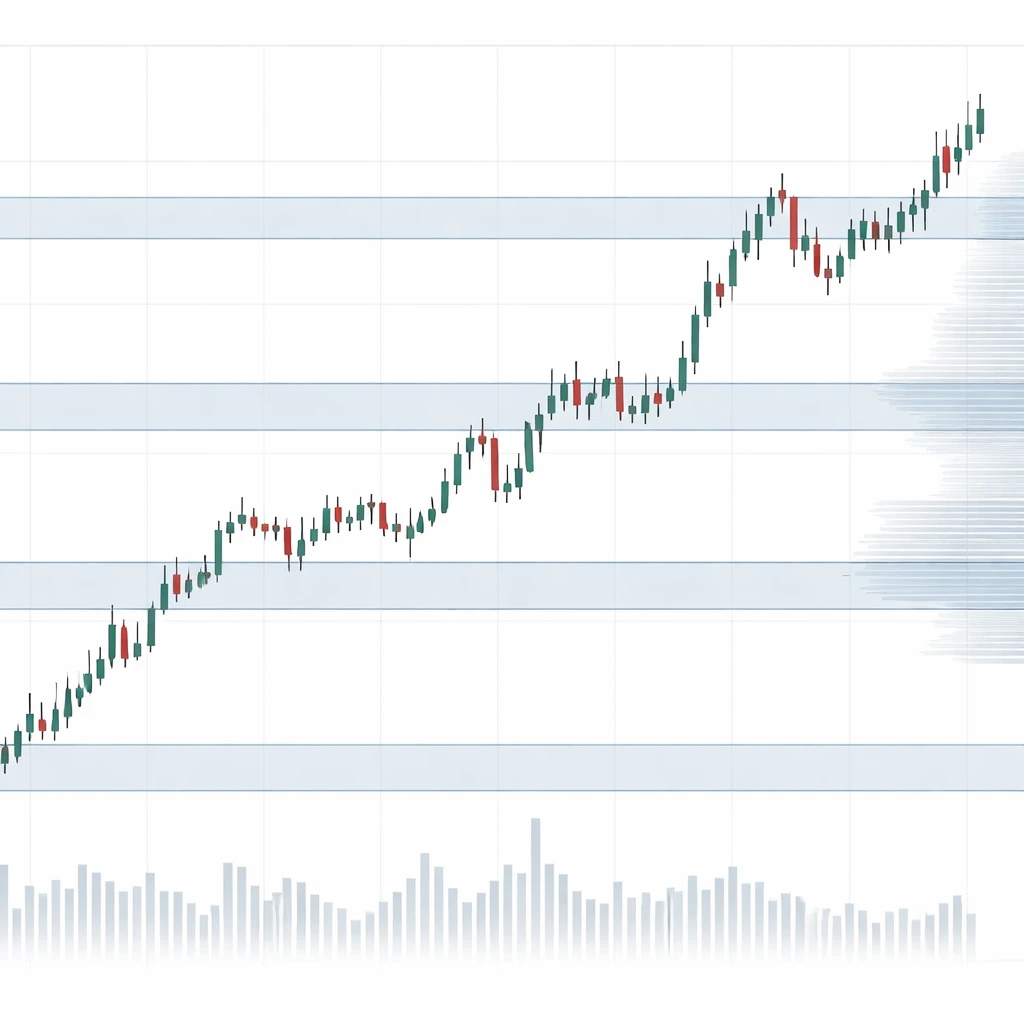
Psychological price levels refer to round numbers or culturally salient thresholds that market participants watch closely and often act upon. These prices serve as focal points where orders cluster, attention intensifies, and short-term order flow can behave differently than it does in the middle of a price range. In technical analysis, these levels are discussed as a particular case of support and resistance that arises less from firm-specific fundamentals and more from shared human tendencies, conventions, and institutional practices.
Defining Psychological Price Levels
At its core, the idea is simple. Traders and investors frequently anchor on easily memorable numbers. Examples include 100, 1,000, or 5,000 on equity indices, 100 dollars for a commodity, 1.0000 parity in a currency pair, or the nearest 10 or 50 increment on a single stock. Because many participants place orders near these prices, the market can display concentrated activity around them, and price can hesitate, reverse, or accelerate as it approaches and interacts with these thresholds.
In practice, psychological prices are not razor-thin lines. They operate as zones with a width that depends on volatility, tick size, and market depth. A highly liquid currency pair may show sensitivity within a few ticks of 1.0000. A volatile equity index might treat 5,000 as a broader area that spans several points or more. The concept is probabilistic, not deterministic. The level increases the chance that distinctive behavior occurs, but it does not ensure any single outcome.
Why Round Numbers Matter
The influence of psychological levels is often linked to behavior and institutional conventions:
- Anchoring and salience: Humans categorize and remember round numbers more easily than irregular ones. This shapes expectations and discussions. Market commentary frequently references milestones such as an index nearing 5,000 or crude oil testing 100 dollars.
- Left digit and threshold effects: A change in the first digit of a price can feel significant even when the percentage difference is small. Moving from 99.8 to 100.2 in a stock shifts perception more than a move of equal size that does not cross a digit boundary.
- Order placement habits: Stop losses, take profits, and limit orders often cluster around round numbers because rules, guidelines, or habit direct users to choose simple increments. Institutions that need to execute large orders may stage them in blocks around big figures.
- Conventions in specific markets: Foreign exchange participants refer to the big figure, the first two or three digits of a quote. Parity levels such as 1.0000 in EURUSD receive special attention. Options markets list standardized strikes at round numbers, which can influence spot price behavior as expiration approaches.
These mechanisms do not always operate with the same intensity. Market conditions, liquidity, and news can overwhelm the pull of any specific level. Nonetheless, the repeated visibility of round numbers means they remain important reference points for chart readers.
How Psychological Levels Appear on Charts
On a chart, psychological levels often appear as horizontal areas where price stalls or reacts. Visual cues include small consolidations just before reaching a round number, quick rejections on first touch, and multiple tests across sessions. Traders who mark 50, 100, or 1,000 increments can often see such microstructures without requiring complex indicators.
There are common signatures:
- Approach hesitations: Momentum weakens as price nears a round number. Candles become smaller, intraday oscillations tighten, or volume rises as both sides become active.
- Touch and recoil: Price tags the level and backs away. The reaction can be a minor pause in a larger trend or a sharper swing if the order book contains significant resting volume.
- Pierce and close: Price briefly crosses the level but closes back below or above it. On higher timeframes, this looks like a wick. On intraday charts, it can be a sweep of resting stops followed by a return into the prior range.
- Acceptance: After several interactions, price trades through and begins to build value on the other side. Consolidation appears around the level before the market commits to a new region.
These patterns are examples, not rules. A powerful catalyst can push cleanly through any round number without hesitation. The same level that causes hesitation one day may be less influential on another.
Psychological Levels as Support and Resistance
Psychological levels often behave similarly to classical support and resistance. If price approaches 100 from below and sellers appear, the level functions as resistance. If price later approaches 100 from above and buyers appear, the level acts as support. The intuition is straightforward. Market participants remember notable prices and respond to them. A round number associated with a prior reversal can become more salient, reinforcing its behavioral pull.
Importantly, these levels are better understood as areas rather than precise ticks. Spreads, volatility, and order-routing delays mean reactions often occur several ticks shy of or beyond the number itself. Defining a zone around the level helps avoid a binary interpretation of hold or fail.
Microstructure and Order Flow Considerations
To understand why behavior clusters near psychological prices, it helps to consider order flow:
- Resting liquidity: Limit orders are often placed at round numbers, either due to preference or algorithmic slicing rules. These orders can temporarily absorb market orders and slow price movement.
- Stop clusters: Traders often place stops just beyond obvious levels. Sweeps through a round number can trigger a cascade of market orders, increasing volatility over a short interval before price stabilizes.
- Inventory management: Market makers and liquidity providers adjust inventories near well watched thresholds. This can change quoted size, spreads, or the aggressiveness of fills.
- Options strikes and hedging: Standardized strikes at round numbers often coincide with hedging flows. As expiration nears, the interaction between options positioning and dealer hedging can affect the tendency of spot prices to fluctuate around a strike.
None of these elements guarantees direction. They simply explain why distinctive price behavior may occur in the vicinity of psychologically salient prices.
Cross-Market Examples
Examples across asset classes illustrate how widely the concept appears. The following are stylized descriptions intended to clarify the mechanism rather than to imply specific outcomes.
- Equity index near 5,000: As an index approaches a thousand-point milestone, financial media and market commentary increase coverage. Chart watchers often draw a horizontal line at the milestone and note the frequency of intraday tests. Several sessions might show price pressing toward the level late in the day, fading slightly, then returning the next morning. Eventually the index may spend time consolidating around the milestone before trading in a higher or lower region.
- Crude oil near 100 dollars: The 100 threshold in oil has historic resonance and attracts significant attention. Price can oscillate around the level over several days with expanding intraday ranges. Order books may display larger sizes at or just below 100 when the market is rising and at or just above 100 when the market is falling.
- Currency pair at parity: Parity in EURUSD, 1.0000, is watched across global markets. During an approach to parity, intraday charts often show tight clustering of candles just above the level, followed by sharp moves on brief breaks. After initial interactions, the pair might range slightly above and below the mark while participants reassess value.
- Single stock at a round hundred: A widely held stock approaching 300 can show late-day runs toward the number on strong days and quick rejections on weaker days. Options open interest at 300 may be elevated, adding to attention as monthly or quarterly expirations near.
These sketches highlight visibility and memory. The level is not important because of a model output. It is important because the community of traders cares about it and acts around it.
Measurement and Evidence on the Chart
Several tools can help interpret whether a round number is active in current conditions:
- Volume at price: A histogram aligned with price often shows bulges near round numbers if substantial trading has occurred there. A large bulge suggests acceptance, while a gap suggests swift moves through that area.
- Intraday volume spikes: Spikes in time and sales near a round number, or increased tick-by-tick volatility, can signal dense order interaction.
- Candlestick structure: Repeated long wicks around the level indicate frequent probes that were rejected. Consecutive closes on one side indicate increasing acceptance.
- Options data: Elevated open interest at a round-number strike can correlate with attention on that level. It can be informative to compare upcoming expirations and nearby strikes to see whether one threshold stands out.
- Anchored VWAP or moving averages: When a round number aligns with a well followed average or an anchored VWAP from a significant event, the combined salience can be greater than either factor alone.
None of these tools is required to observe psychological levels. A clean price chart with horizontal lines at salient increments often suffices for interpretive work.
Timeframe Considerations
The significance of psychological levels is context dependent across timeframes:
- Intraday: On liquid instruments, 50 or 100 increments can act as micro balance points. Price may pause multiple times at the same level within a single session. Order book dynamics dominate, and levels can be respected to the tick or overshot by a small spread.
- Daily and weekly: Larger milestones such as 1,000 or 5,000 can feature in multiweek consolidations. Earnings seasons or macro events can shift attention toward or away from these levels quickly.
- Longer term: On monthly charts, psychological levels that coincide with prior cycle highs or lows can display stronger memory. The zone around such levels becomes part of the long-term narrative for the asset.
The appropriate width of a psychological zone scales with volatility. When average ranges expand, it is typical to see wider oscillations around round numbers. During calm periods, the market can respect the level tightly.
Interactions with Other Technical Concepts
Psychological levels rarely operate in isolation. Confluence matters for interpretation because multiple independent reasons to focus on the same area can heighten activity:
- Trendlines and channels: A round number intersecting a trendline often becomes a focal point for whether the trend remains intact. How price behaves at that intersection can set the tone for near-term narrative.
- Fibonacci retracements: A 50 percent or 61.8 percent retracement that aligns with a round number receives additional attention from participants who track both.
- Gaps and prior highs or lows: If a round number coincides with a previous gap fill, swing high, or swing low, the memory of past reactions can amplify the response.
- Pivot points: Floor trader pivots or other calculated levels sometimes sit close to round numbers. Agreement between a calculated reference and a psychological one often increases interest.
These intersections do not produce certainty. They help explain why activity can concentrate within a specific band on the chart.
Common Price Behaviors Around Psychological Levels
While outcomes vary, several recurring behaviors appear around these levels. These are descriptive patterns, not instructions:
- Compression then expansion: Price volatility contracts as the market approaches the level, followed by a burst of activity as latent orders interact. This is visible as a sequence of small candles, then a larger candle or a series of fast ticks.
- Multiple probes: Price may test a round number several times within a session or across days. The number of tests does not guarantee a break or hold, but repeated tests indicate the level remains relevant to participants.
- Undershoot and overshoot: Approaches often fall short by a small amount or run slightly through the level before reversing. This reflects the presence of stops and spreads, as well as strategic behavior by liquidity providers.
- Flip of role: A level that capped price for a period may later support it. This is consistent with the general principle of resistance turning into support once price trades and accepts above it.
- Whipsaw around expiration or news: Options expirations, index rebalances, or major economic releases can produce quick swings on both sides of a psychological level as flows rebalance.
Practical Chart-Based Context
A concrete, chart oriented context helps fix the idea. Consider a liquid stock oscillating between 92 and 108 over several weeks, with 100 acting as a clearly visible midpoint. Several features may be observed:
- Daily candles frequently close near 100 after intraday swings, indicating repeated return to a perceived fair region.
- Volume at price shows a bulge centered on 100, suggesting significant transactions at that zone.
- On approaches from below, 100 produces several initial hesitations, small upper wicks, and higher traded volume. Intraday data reveals that limit sell orders accumulate at 99.90 to 100.10, while buy stops sit above 100.20.
- A short, sharp break prints 100.35, triggers visible stop activity, then the stock settles back to 99.95 by the close. On the daily chart this appears as a wick through the level.
- Later, earnings are released. The stock gaps to 104 on the open. During the following week, pullbacks repeatedly slow near 100 to 101, turning the round number into a support zone rather than resistance.
This description is not a template for decision making. It is a narrative showing how participants may orient to a psychological level over time, and how the same level can play different roles as information changes.
Context, Liquidity, and Market Regime
Psychological levels interact with broader conditions. In high liquidity regimes with narrow spreads, round numbers can exhibit precise reactions because order books are deep and the market digests flows efficiently. In low liquidity regimes, round levels can be punctured quickly and by greater amounts. The same level can feel solid one month and porous the next.
Macro events alter the landscape. When a central bank surprises markets, currency pairs can cut through parity with little pause. During quiet periods, the same parity may act as a magnet that price oscillates around for days. The broader volatility environment shapes the width of the zone and the durability of behavior observed near it.
Limitations and Pitfalls
Psychological levels can be overemphasized. Several pitfalls are worth noting:
- Post hoc storytelling: It is easy to draw a horizontal line after the fact and claim significance. The value lies in consistently marking levels in advance and observing without selective memory.
- Data snooping and overfitting: Searching charts for perfect reactions at round numbers can lead to biased conclusions. Imperfect interactions are the norm.
- Ignoring volatility and tick size: A five-cent precision around 100 in a low priced stock might be meaningful. The same precision is not meaningful for an index that trades in five point increments.
- Neglecting liquidity conditions: Thinly traded assets may show erratic behavior around any level, round or not. Spikes or gaps can be random reflections of low depth rather than true reactions to psychological prices.
- Assuming causality: Attention and order clustering can influence behavior, but they do not cause a specific outcome. Fundamentals, news, and broader positioning can dominate.
Documenting and Evaluating Psychological Levels
For those engaged in analytical study, a structured approach helps maintain objectivity:
- Define a set of round numbers appropriate to the instrument. For indices, thousands and hundreds are common. For currencies, parity and half-figures. For single stocks, 10s, 50s, and 100s depending on price.
- Record interactions in a journal with timestamped chart images. Note the direction of approach, immediate reaction, and subsequent behavior within a set window of time.
- Measure context variables such as realized volatility, proximity to earnings or economic releases, and options open interest distribution.
- Compare behavior across regimes. A level that consistently produces hesitation in quiet markets may be less notable in high volatility regimes.
- Evaluate zones rather than points, and recalibrate zone width as volatility changes.
This style of documentation supports more disciplined interpretation of what is truly recurring versus what is isolated and time specific.
Putting Psychological Levels in Broader Technical Perspective
Psychological levels are one category within a larger framework of reference prices. Others include prior highs and lows, gaps, moving averages, and mathematically defined levels such as pivot points. No single category dominates across all markets and times. The market is a complex adaptive system that shifts where attention concentrates. Round numbers matter because many participants prefer them, discuss them, and place orders around them. That social fact makes them visible on charts, even though they are not derived from fundamental valuation models.
When psychological levels align with other references, the likelihood of observable interaction tends to increase. If a round number coincides with a major earnings gap and a widely followed moving average, more participants notice that area. The result is more two sided activity and a higher chance that the tape looks distinctive when it reaches the zone.
Additional Considerations from Options and Derivatives
Options markets reinforce psychological levels through strike selection. Many listed strikes are set at round increments, and open interest can be concentrated at a prominent strike. The hedging activity of dealers and systematic strategies tied to those options can influence how spot trades near the strike as expiration approaches. Readers sometimes describe a strike as a magnet when gamma exposures are high. While the specific microstructure effects vary, the common point is that standardized round strikes create mechanical reasons for attention to cluster at those prices.
Futures markets also display round-number salience, especially where contract specifications naturally highlight certain prices. Calendar rolls, delivery considerations, and margin thresholds can interact with psychological levels in subtle ways. Analysts studying these effects often compare spot, futures, and options data to understand whether the round number is a genuine focal point in the current cycle.
Practical Illustration with a Hypothetical Chart
Consider a futures contract trading around 4,980 to 5,040 with 5,000 as a visible center. A simple interpretation sequence might look like this:
- Mark the level: Draw a horizontal line at 5,000 and a zone from 4,995 to 5,005 to reflect typical spread and volatility.
- Observe the approach: On a morning rally from 4,975, candles shorten as price nears 4,995. Volume increases. The tape shows several quick prints at 4,999 to 5,001.
- Initial interaction: The first touch produces a small pullback to 4,992. Sellers were present at the figure. A second test breaks 5,000 by a few ticks, triggering stops, then price rotates back into the zone.
- Development: Over the next hour, the market oscillates between 4,996 and 5,006, building volume at price. The level is now an area of short-term value rather than a single barrier.
- Transition: Later in the session, a news headline hits. Price drives to 5,020 without pause. After an afternoon pullback, buyers defend 5,005 to 5,010. The psychological level has flipped from a pivot to a support zone.
Each step highlights behavior without suggesting a particular action. The purpose is to show how a psychological price can serve as a reference point for describing market structure over the day.
Responsible Interpretation
Sound interpretation treats psychological levels as informative but limited. They can help frame a narrative about where price may pause or accelerate. They can support careful reading of auction dynamics. They do not replace analysis of trend, momentum, volatility, or fundamental catalysts. They are most useful when incorporated as one element among several, with a clear understanding that market behavior remains uncertain.
Key Takeaways
- Psychological price levels are round or salient numbers that attract attention and often act as support or resistance zones.
- They arise from human behavior, institutional conventions, and standardized features of markets such as options strikes.
- On charts, these levels appear as horizontal areas where price hesitates, reverses, or briefly overshoots before stabilizing.
- Evidence for an active level includes clustered volume at price, distinctive candlestick behavior, and confluence with other technical references.
- The concept is probabilistic. Psychological levels influence behavior but do not imply specific outcomes, and their effect varies with volatility, liquidity, and news.