
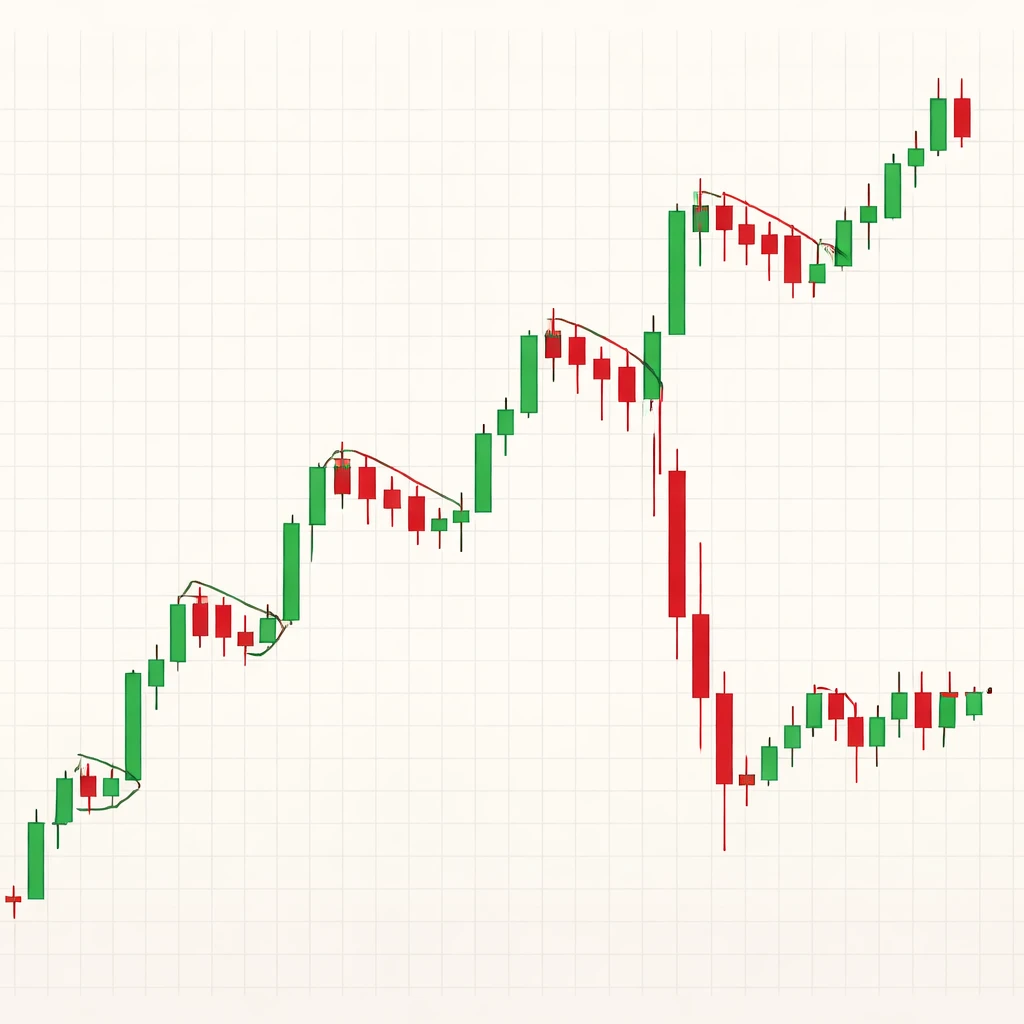
Price action analysis often begins with a simple observation: markets move in waves. Some waves cover a large distance in a short amount of time, while others meander, retrace, or pause. Technical analysts commonly describe these two modes as impulsive moves and corrective moves. Although the labels sound straightforward, they carry a structured way of interpreting chart behavior. The distinction helps frame whether the market is advancing a trend or digesting prior movement, and it informs how analysts judge context, momentum, and the balance between urgency and hesitation in price.
Defining Impulsive Moves
An impulsive move is a decisive price swing that travels a meaningful distance in relatively little time. On candlestick charts, impulsive sequences often feature large real bodies, limited overlap from one candle to the next, and closes near the session’s extremes. Impulsive legs frequently break prior swing highs in an uptrend or swing lows in a downtrend. The path is usually direct, with minimal back-and-fill behavior.
Several descriptive traits commonly accompany impulsive phases:
- Range expansion: candle ranges expand relative to the preceding sequence, and the price covers more ground per unit of time.
- Continuity and follow-through: consecutive candles often align in the same direction, and pullbacks within the sequence are short-lived.
- Structure-breaking behavior: prior swing points give way, indicating progress rather than containment.
- Urgency: the market appears to prioritize reaching new territory over testing intermediate levels.
None of these elements alone is decisive. What matters is the cluster of features: speed, distance, and structural progress occurring together. Impulsive moves can occur in any direction. In a range, an impulsive drive may run from the lower boundary toward the upper boundary, or it may briefly exit the range entirely.
Defining Corrective Moves
A corrective move is a pause or counter-swing that reworks or retraces part of a prior impulse. Corrective legs tend to be slower, more overlapping, and often limited by the boundaries set during the preceding advance or decline. They may drift sideways or channel gently against the preceding direction. The essence of a correction is not its label as bullish or bearish, but its function: it reorganizes price after an accelerated move.
Common characteristics of corrective phases include:
- Overlap and hesitation: candles frequently retrace the prior candles’ progress, creating choppy sequences.
- Range contraction: average ranges shrink compared with the preceding impulse.
- Partial retracement: price gives back a portion of the prior leg rather than eclipsing it. Depth varies by market and context.
- Time-consuming behavior: corrections often take more time per unit of price change than impulses.
Corrections can unfold as simple pullbacks that retrace a fraction of the impulse, or as sideways consolidations that digest prior gains or losses through time instead of distance. A correction that drifts for many sessions without materially advancing or reversing can still perform the same role as a quick pullback. In either form, the defining feature is that the market is organizing and absorbing prior movement, not accelerating to new extremes.
How the Concept Appears on Charts
Charts communicate impulse and correction primarily through the rhythm between distance and time. Consider a daily uptrend that prints a series of strong upward candles across three sessions, taking out a prior swing high. If the next week presents small-bodied candles that overlap, with intraday highs and lows contained within a narrow band, the market is likely in a corrective phase. If the containment breaks with another run of large candles pushing to fresh highs, the next impulse is underway.
In downtrends, the logic is symmetrical. Sharp declines with large-bodied red candles and brief, two- or three-candle pauses suggest impulsive downside followed by corrective bounces. If the bounce fails to recover the bulk of the decline and then gives way to another strong down leg, the structure aligns with impulse-correction-impulse in the downward direction.
Sideways markets also contain impulses and corrections, although the label depends on the local context. A quick surge from the middle of the range to the upper boundary is impulsive within the range, while the subsequent drifting pullback toward the center may be corrective. The absolute magnitude can be small, but the pattern of urgent vs hesitant movement still applies.
Why Analysts Pay Attention to Impulse and Correction
The impulse-correction framework provides several practical benefits for interpretation:
- Trend health: in trending environments, persistent impulses in the same direction with shallow, contained corrections point to ongoing trend strength. Deep or time-consuming corrections may indicate a change in balance, even if a formal reversal has not occurred.
- Context for patterns: many chart patterns, such as flags, wedges, and channels, are specific forms of corrective action. Recognizing them as corrections clarifies that their function is to digest prior movement.
- Expectation setting: before any trading decision, analysts often consider whether the market is more likely to accelerate or to consolidate. Assessing impulse vs correction helps set expectations for volatility and path.
- Structural clarity: the framework separates price moves that carry the market to new territory from those that rework prior territory. This aids in distinguishing continuation risk from reversal risk.
A Practical, Chart-Based Context
Suppose a stock rallies 8 percent over two sessions with unusually wide daily candles that close near their highs. On the third session the price briefly makes a new high and then stalls. Over the next six sessions, the stock oscillates within a tight 3 percent band, printing small-bodied candles with alternating colors and frequent intraday reversals. The oscillation holds above the midpoint of the two-day rally. This sequence reads as an impulse followed by a correction through time rather than through deep retracement. If a subsequent day produces another wide-range move that closes at a new high, the chart shows a second impulse advancing the trend.
Consider a currency pair that falls 2 percent in one hour after an economic release. The decline is marked by consecutive long red candles and minimal overlap. Over the next three hours, the pair recovers roughly half of the drop through a choppy upward grind of small candles. Price then stalls beneath the midpoint of the initial selloff and pivots lower again. This sequence illustrates a fast impulse, a corrective bounce, and a potential renewal of pressure that corresponds to another impulsive leg. Regardless of any subsequent outcome, the anatomy of the move is clear: urgency, digestion, and renewed urgency.
In a broad equity index, imagine a month where the index advances rapidly in the first week, then trades sideways for two weeks, then advances again into month-end. The two-week consolidation represents a correction through time, which allowed the index to hold ground while absorbing the earlier advance. Some corrections will be deeper, giving back a larger share of the move, while others will be shallow. The depth, duration, and shape of the correction contextualize the next leg in the sequence, without guaranteeing it.
What Separates Impulsive From Corrective
Although the boundary between impulse and correction is somewhat qualitative, several observable features tend to separate them. Analysts often use a blend of these, not a single criterion:
- Distance per time: impulses move far in little time. Corrections move little over more time, or reverse a portion of the move without making new structural ground.
- Candle anatomy: impulses favor larger bodies and closes near extremes, while corrections feature smaller bodies, longer wicks, and more alternating colors.
- Overlap and swing structure: impulses tend to avoid deep intrasequence overlaps and often break prior swing points. Corrections overlap frequently and usually stall under, or just beyond, prior swing points.
- Retracement depth: corrections often retrace a fraction of the prior impulse. Common language references include one-third to two-thirds retracements. These are descriptive tendencies, not fixed rules.
Measuring Impulse and Correction
Price analysis often benefits from simple, transparent measures. Although the assessment remains partly qualitative, several practical measurements can help frame the observation:
- Range analysis: compare the average true range or average candle size during the candidate impulse to that of the preceding correction. An impulse usually shows a meaningful expansion.
- Time-price ratio: divide the price change by the number of bars. Higher values usually correspond to impulsive behavior.
- Retracement percentage: calculate the percentage of the impulse that the correction has retraced. Shallow, contained retracements often signify compression rather than reversal.
- Swing progression: note whether the move has broken and closed beyond prior swing highs or lows. Progress confirms that the market has escaped the prior structure.
These tools do not force a conclusion. They provide a consistent language for comparing phases across instruments and timeframes. The same principles apply intraday and on monthly charts, which underscores the fractal character of market movement.
Timeframe Considerations
Impulsive and corrective behavior is relative to timeframe. A correction on a daily chart can contain several impulsive moves on a 15-minute chart. Conversely, a 15-minute impulse can be invisible noise on a weekly chart. The analyst’s primary timeframe sets the lens. It is useful to observe at least one higher timeframe for structural context and one lower timeframe for refinement, while always keeping the main lens in focus.
Time-of-day effects also matter on intraday charts. Liquidity and participation often vary across the session. A swift opening move can look impulsive relative to the quiet midday drift. Recognizing these seasonal rhythms reduces the chance of mislabeling every early burst as an impulse of major significance.
Corrections by Shape: Pullback vs Consolidation
Corrections show two broad shapes: pullbacks and consolidations.
- Pullback: a countertrend move that gives back a portion of the impulse. Pullbacks can be sharp or gentle. Depth and duration carry information about how much pressure the counter side can apply.
- Consolidation: a mostly sideways sequence with contained highs and lows. Consolidations reduce directional energy without materially reversing the prior move, which allows trend metrics to stabilize.
Both forms can serve the same function. Variations such as flags, channels, and triangles are specific manifestations of corrective price behavior. The purposeful aspect is digestion, not immediate continuation or reversal.
Impulse, Correction, and Trend Construction
Trends are built from alternating impulses and corrections that favor one direction. In an uptrend, upward impulses tend to be long and decisive, while downward corrections are shorter, shallower, and more overlapping. If the pattern begins to invert, where downward legs become more impulsive and upward legs become corrective, the trend may be losing traction. The transition can be gradual. Many turning points are not signaled by a single event, but by a series of legs that shift the balance of urgency.
Trend lines and channels can help visualize this balance. When impulses carry price to the upper boundary of a rising channel in fewer bars than corrections take to drift to the lower boundary, the trend is asserting itself. If corrections start to consume more bars and encroach more deeply into the channel, momentum may be fading. The market’s slope and path through the channel convey how pressure is distributed over time.
Impulse and Correction in Classical Frameworks
Several traditional schools of technical thought interpret these ideas in distinctive ways. Dow Theory emphasizes higher highs and higher lows in uptrends and the reverse in downtrends. In this framework, impulsive moves are associated with swings that establish new highs or lows, while corrective phases rework prior ground without breaking the key pivot structure. Elliott-style analysis uses the language of motive and corrective waves. Although notation varies, the intuition is consistent: one phase drives progress, the other restructures the path.
Even without adopting a particular doctrine, recognizing that markets tend to alternate between expansion and digestion is useful. The core idea remains neutral and descriptive: a market alternates between pushing forward and catching its breath.
Common Pitfalls and Misclassification
Labeling impulsive and corrective phases involves judgment, which opens the door to several errors:
- News-driven spikes: a single candle can be large and dramatic, yet fail to lead to any follow-through. Classifying every spike as an impulse risks overemphasizing one-off events.
- Low-liquidity distortions: thin trading hours or instruments can produce exaggerated candles that look urgent but do not reflect broad participation.
- Ignoring context: a move that appears impulsive inside a tight range may be corrective when viewed on a higher timeframe. Without context, labels can flip based on zoom level alone.
- Chasing symmetry: not all impulses and corrections will have neat proportional relationships. Forcing symmetry where none exists can mislead analysis.
Careful analysts remain flexible and allow for ambiguity at boundaries. A sequence can begin as a correction and morph into an impulse if it accelerates, breaks structure, and attracts participation. Likewise, an apparent impulse can stall and revert to a range. The classification is an interpretation of behavior, not a guarantee about what follows.
Assessing Depth, Duration, and Shape
When judging a correction, three observations are particularly informative:
- Depth: how much of the prior impulse has been retraced. Shallow pullbacks imply strong sponsorship of the prior move, while deep retracements signal two-sided pressure.
- Duration: how many bars the correction consumes relative to the impulse. Corrections that take two or three times as many bars as the impulse often indicate absorption through time.
- Shape: whether the correction is a quick countertrend jab or a flat consolidation. Shapes influence the probability of abrupt expansions vs gradual transitions, without dictating outcomes.
These observations do not prescribe action, but they do refine expectations about the character of subsequent movement. For example, a flat, multi-session consolidation may precede either a sharp expansion or a failed break and reversion. The preceding trend, participation, and the integrity of boundaries help interpret which path is more consistent with the observed state.
Multi-Leg Sequences and Continuity
Price sequences often unfold as a chain of impulses and corrections. Continuity describes how cleanly one impulse hands off to the next. High continuity appears when a correction remains contained and transitions quickly into a fresh impulse in the same direction. Low continuity appears when the market oscillates indecisively, with frequent failed breakouts and re-entries into the prior range.
Continuity is not a forecast tool. It is a descriptive lens for the smoothness of a trend’s internal structure. An environment with high continuity tends to feature longer runs of directional bars and fewer abrupt reversals. An environment with low continuity tends to frustrate trend measurements, as impulses degrade quickly into noise.
Examples Across Markets
Equities: A broad index surges 3 percent in three days on large candles that close near their highs. The next eight sessions form a tight rectangle with small bodies and overlapping highs and lows. The rectangle represents correction through time. If the index later exits the rectangle with another multi-day burst, that advance functions as the next impulse in the sequence.
Foreign exchange: A currency pair drops 1.5 percent over a morning session, then spends the afternoon retracing 40 percent of the move in a jagged pattern of alternating candles. The afternoon sequence is corrective. If the pair resumes lower overnight, the decline shows an impulse-correction-impulse structure. If it instead recovers the entire drop and holds, the initial decline may be reinterpreted as a failed impulse or as a range expansion without follow-through.
Commodities: A futures contract rallies strongly into a prior supply region, hesitates with several inside days, and then drifts lower in a shallow channel. The hesitation and gentle channeling indicate correction. Whether the contract later breaks higher or rolls over, the corrective label remains a description of the interim behavior, not a verdict on future direction.
Limitations of the Framework
Several limitations deserve emphasis:
- Non-uniqueness: different observers can label the same sequence differently, especially near turning points.
- State changes: a corrective move can accelerate and become impulsive, and an impulsive move can stall and become corrective, without warning.
- Incomplete information: price alone may not reveal important drivers, such as liquidity or event risk, that affect how a move behaves.
- No predictive guarantee: recognizing an impulse or a correction does not ensure continuation or reversal. It frames conditions, not outcomes.
A Simple Observational Checklist
An organized process helps maintain consistency when classifying moves. The following checklist is deliberately simple and descriptive:
- Identify the most recent swing high and swing low on the chosen timeframe. Note which side was broken most recently.
- Measure the distance and the number of bars in the latest directional leg. Compare to the prior leg.
- Assess candle anatomy: are bodies large with closes near extremes, or small with long wicks and frequent overlaps.
- Estimate retracement depth of the current pullback or consolidation relative to the last leg.
- Observe whether the current phase is making structural progress or simply rearranging prior ground.
These steps do not prescribe actions in the market. They serve as a disciplined way to read the chart’s language of urgency and digestion.
Putting It All Together
Impulsive and corrective moves organize price history into a sequence of progress and consolidation. The analyst’s task is to read that sequence across timeframes and instruments, noting how quickly the market travels, how deeply it retraces, and whether it breaks or respects prior structure. Impulses communicate urgency and directional intent. Corrections communicate hesitation and rebalancing. Both phases are essential to how trends form, persist, and eventually transition.
Key Takeaways
- Impulsive moves are swift, directional, and structure-breaking, while corrective moves are slower, overlapping, and reorganize prior progress.
- Charts reveal the distinction through distance per time, candle anatomy, overlap, and retracement depth across any timeframe.
- The impulse-correction framework helps assess trend health, contextualize patterns, and set expectations about volatility without predicting outcomes.
- Timeframe context matters: a correction on one timeframe can contain impulses on a lower timeframe, and vice versa.
- Classification involves judgment and can change as conditions evolve, so the framework should be applied flexibly and conservatively.