
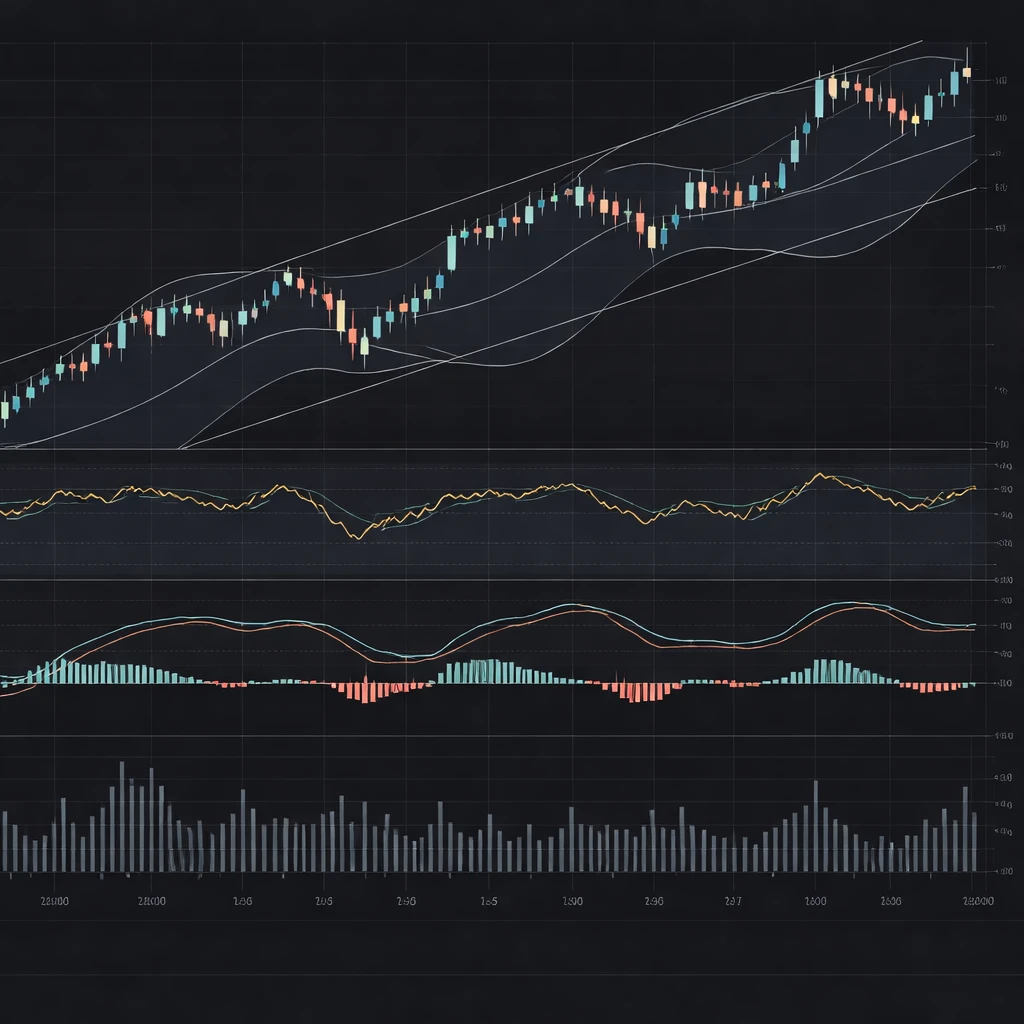
Technical indicators and oscillators summarize aspects of market behavior by transforming price and volume into derived signals. They compress information into forms that are easier to scan and compare: momentum readings, moving average relationships, breadth measures, volatility bands, and similar constructs. Despite their usefulness, indicators often fail. A failure occurs when a commonly recognized signal does not lead to the price response it is widely believed to imply. The failure itself carries information about supply and demand, the prevailing regime, and the balance of expectations.
This article defines the concept of when indicators fail, describes how failures appear on charts, explores why market participants pay attention to them, and presents practical contexts that illustrate the idea. The objective is not to propose strategies. The focus is interpretive: what a failure suggests about the interaction between indicators, price, and market structure.
Definition: What It Means When Indicators Fail
When indicators fail refers to observable situations in which a widely used indicator issues a recognizable condition or signal, yet price does not behave in the expected manner within a reasonable window of time or magnitude. Failure is not disappointment in a forecast. It is a structural mismatch between signal and market response.
Because indicators are transformations of price and volume, they do not predict; they codify tendencies. A failure highlights that either the tendency did not materialize or that another force dominated. Defining failure requires explicit criteria. Below are archetypes used in practice to label failures:
- Non-response failure. An indicator flags a condition, but price does not move in the expected direction by a minimal distance or within a minimal number of bars. For example, a momentum oscillator issues a bearish signal, yet price holds steady or grinds higher for several sessions.
- Immediate reversal failure. A signal triggers, then rapidly flips back or is invalidated. For instance, a moving average crossover occurs, and the averages uncross a few bars later without meaningful price follow-through.
- Persistence failure. An indicator remains at an extreme without eliciting the anticipated mean-reverting movement. A classic case is the Relative Strength Index staying overbought for a prolonged trend phase while price advances.
- Confirmation failure. A secondary indicator or related market variable does not confirm a primary signal. Price breaks out while a volume-based indicator weakens, or breadth deteriorates while an index rises. The gap between them persists and the supposed implication of the primary signal does not materialize.
Failure always depends on definition. It rests on pre-specified thresholds of time, magnitude, and context. Without clear thresholds, any outcome can be rationalized after the fact, which reduces the concept to hindsight labeling.
How Indicator Failures Appear on Charts
Indicator failures have visual signatures that repeat across instruments and time frames. Recognizing them requires paying attention to both the indicator pane and the price pane, and to the timing between the two.
Oscillators that do not trigger reversals
Oscillators such as RSI, Stochastic, or Commodity Channel Index often provide clear overbought and oversold zones or signal-line crosses. A failure appears when those conditions persist or flip back quickly while price resists reversing. Typical chart features include:
- Extended extremes. RSI spends many bars above 70 while price advances in a stair-step pattern. The anticipated pullback does not arrive, or it is shallow and brief relative to the time spent at the extreme.
- Whipsaw crosses. A series of quick Stochastic crosses around the signal line while price compresses in a tight range, then resolves in the opposite direction of the initial crosses.
- Divergence that stalls. Bearish divergence forms as price makes a marginal higher high while the oscillator makes a lower high. Instead of rolling over, price consolidates sideways and then makes another higher high that negates the divergence.
Trend indicators that flip and unfip
Trend-following tools like moving averages, Average Directional Index components, or MACD can fail when early flips do not transition into a sustained trend. Visual cues include:
- Fast crossover, fast uncross. A short moving average crosses below a longer average by a small margin. Price fluctuates around the longer average and the short average quickly recrosses upward. Both lines flatten, signaling indecision rather than trend initiation.
- MACD cross without momentum. A bearish MACD signal line cross occurs while histogram bars remain small and oscillate around zero. Price drifts rather than accelerates, and the next cross negates the first within a short span.
- ADX stagnation. Directional lines briefly flip positions, then revert while ADX fails to rise. The chart shows no expansion in range or volatility, implying that the supposed trend transition lacked participation.
Volatility bands and breakout tools that do not hold
Indicators built around volatility, such as Bollinger Bands or Keltner Channels, often imply that a close outside a band may precede continuation. Failures typically look like:
- Close outside then re-entry. Price closes beyond the upper band on a wide candle, then the next bar closes back inside the band and the following bars remain inside. The initial breakout does not see follow-through.
- Squeeze that drifts. A well-formed band squeeze resolves with a break, but range expansion does not occur. Volatility remains muted and price oscillates near the breakout level.
- Multiple band tags without progress. Several upper band tags occur in sequence while net price progress stalls. The repeated signals fail to produce directional expansion.
Volume and breadth indicators that refuse to confirm
Volume-weighted measures such as On-Balance Volume, Accumulation-Distribution, or money flow versions can decouple from price. Breadth indicators across a group of securities behave similarly. Failure appears as:
- Non-confirmation. Price records a new swing high, but OBV does not. The gap persists for many sessions without a price breakdown.
- Volume fade during breakout. A range break occurs on modest volume and volume remains subdued. The lack of expansion fails to validate the implied enthusiasm, yet price does not revert immediately.
- Sector or index breadth divergence. A cap-weighted index rises while equal-weight measures lag. Despite the divergence, price continues to climb, suggesting concentration rather than broad strength.
Why Market Participants Pay Attention to Failures
An indicator failure is not merely a missed forecast. It is an information event that says something about forces not captured by the indicator. There are several reasons practitioners study failures:
- Asymmetry of expectations. Many participants watch similar indicators. When a widely observed signal does not play out, it hints that the balance of orders overwhelms the crowd’s default interpretation.
- Regime diagnosis. Failures cluster during regime changes. A shift from mean-reverting to trend-dominated behavior, or from low to high volatility, often coincides with strings of signals that stop working as they did in the recent past.
- Time frame conflict. Short-term signals can fail when higher time frame trends dominate. Tracking failures helps identify which time frame is exerting control.
- Liquidity and event effects. Around earnings, policy decisions, or macro data, indicators fail more often because gap risk and order imbalances are elevated. Recognizing this pattern sharpens interpretation.
- Learning about indicator limits. Each indicator abstracts reality. Failures reveal the abstraction’s blind spots, which refines how one reads the tool.
Practical Chart-Based Contexts
The following chart contexts are illustrative. They show how failures appear. They are not prescriptive trade setups.
RSI stays elevated while price grinds upward
Imagine a daily chart of a liquid index during a sustained advance. RSI crosses above 70 and remains between 68 and 78 for twelve sessions. Price advances in small candles with shallow intraday dips and closes near highs. Pullbacks measure 0.5 to 1.0 percent and last one to two sessions before price makes fresh marginal highs. Traders who treat 70 as a strict overbought threshold anticipate a reaction that fails to develop. The visual takeaway is that persistent overbought readings, in this context, express strength rather than immediate vulnerability. The indicator did not fail in the sense of being incorrect. It failed to produce the common effect that many expect when RSI tags overbought.
MACD turns down but momentum does not expand
On a 4-hour chart of a large-cap stock, MACD issues a bearish cross slightly above the zero line after a three-week rise. Price dips modestly for two bars, then stalls near a rising 50-period moving average. The histogram bars are shallow and alternate signs around zero. Over the next eight bars, price recovers the dip and prints a new closing high. The sequence illustrates a momentum shift that lacked range expansion. The cross was technically valid yet did not produce the directional behavior associated with genuine momentum rotation.
Bollinger breakout that re-enters the band
On a 1-hour chart, price compresses for two days with narrowing bands. A large candle closes above the upper band on a news-related spike. The next candle opens flat and closes inside the band. Over the next ten hours, price trades within the previous range. Traders who viewed the band break as the start of expansion observe a failed breakout in indicator terms. The band event occurred, but volatility did not expand and directional continuation did not follow.
OBV drift while price edges to a new high
Consider a weekly chart of an index over a multi-month rally. Price makes a marginal new high after a consolidation. OBV, however, has been flat to slightly down for three weeks. Volume on up weeks is average, and down weeks show slightly heavier volume. Despite the non-confirmation, price does not reverse. The failure of OBV to confirm did not carry the usual implication of weakening demand at that time. It may reflect rotation, changes in participation, or differences between turnover and price sensitivity.
Interpreting Failure in Real Time
Interpreting a failure constructively involves treating it as a clue about market state rather than a directive. Three interpretive dimensions shape the reading:
- Time and magnitude thresholds. Define what counts as failure before the fact. For non-response, a threshold might be the absence of a move greater than a chosen multiple of average true range within a certain number of bars. For immediate reversal failure, it could be a signal that flips back within a small count of bars without reaching a minimum excursion.
- Market regime cues. Identify whether the market is trending, mean-reverting, volatile, or quiet. In persistent trends, oscillator extremes often fail to trigger reversals. In ranges, trend flips often fail to sustain.
- Multi-time frame alignment. Observe whether the higher time frame supports or contradicts the lower time frame signal. Failures are more common when lower time frame signals oppose a dominant higher time frame move.
Reading failure as information helps avoid overreacting to single-signal narratives. It also highlights when the crowd’s interpretation is not being rewarded, which can characterize transitions in who controls the tape.
Measurement: Making Failure Testable
To use the concept rigorously, it must be testable. That requires formal definitions and consistent data handling. Core elements include:
- Signal specification. Precisely define the indicator, parameters, and signal rule. For example, RSI crossing above 70 on a daily close.
- Failure rule. Choose thresholds for time and magnitude. For instance, label as failure if a decline of at least X percent does not occur within Y bars after the signal. For re-entry failures, define the number of bars the price must remain beyond a band to count as continuation, and label reversion within Z bars as failure.
- Sample construction. Avoid survivorship bias in securities selection. Include delisted symbols where relevant. Manage overlapping signals carefully to prevent double counting.
- Regime segmentation. Measure failure rates by regime buckets such as realized volatility quintiles, trend filters, or macro calendar periods. Failure is not uniform across states of the world.
- Robustness checks. Vary parameters to test sensitivity. If slight parameter tweaks change failure rates materially, the concept may be fragile.
By making failure explicit and measured, the concept becomes a lens for understanding indicator behavior rather than a story applied after the fact.
Common Causes of Indicator Failure
While each instance has its own drivers, several recurring causes stand out.
- Lag and smoothing. Indicators often smooth data to reduce noise. Smoothing introduces lag. Early in a move, lag can cause crosses that revert quickly as price mean-reverts around its trend estimate.
- Regime non-stationarity. Markets shift between regimes with different distributional properties. Parameters that worked in one period can become miscalibrated in another. The indicator appears to fail more often because the mapping between signal and outcome has changed.
- Volatility clustering. Sudden volatility expansions can invalidate signals generated in a calm backdrop. Oscillator thresholds calibrated to quiet periods become too tight and over-trigger.
- Time frame interference. Lower time frame signals can be overwhelmed by higher time frame flows, such as rebalancing or macro positioning, making the lower time frame indicator appear unreliable.
- Liquidity, gaps, and events. Thin liquidity, opening gaps, or discrete announcements can leapfrog indicator thresholds and render traditional signal sequencing meaningless for a period.
- Crowded interpretations. If many traders anticipate the same outcome from a popular indicator, price can move in a way that traps those expectations. The indicator did not cause the failure. The crowding around it did.
Reading Price Behavior Through the Lens of Failure
When indicators fail, the price chart becomes the anchor. Several interpretive themes are useful:
- Price structure dominates indicators. Support and resistance, swing highs and lows, and the quality of candles or bars often reveal whether initiative buying or selling is present. An indicator that fails to prompt the expected move reinforces the primacy of structure.
- Persistence is information. When an oscillator holds an extreme for a long period without a reversal, the persistence itself is evidence of an underlying imbalance in order flow. The absence of mean reversion is not neutral; it is informative.
- Rejection footprints. In band failures, quick re-entry after an outside close shows that the auction rejected prices beyond the band at that time. The rejection says something about the willingness of participants to transact at the extremes.
- Relative confirmation matters. A single indicator failing to confirm does not negate the price move. The pattern of multiple partial confirmations or partial failures across tools reveals whether participation is broad or narrow.
Illustrative Multi-Indicator Scenario
Consider a liquid futures contract on a 30-minute chart over two weeks:
- During week one, price trends upward in a channel. RSI hovers between 60 and 75, occasionally peeking above 70. Each time RSI touches 70, price pauses for one to two bars but does not reverse, and then continues to climb.
- Midway through week two, MACD prints a bearish cross at a prior swing high. Price dips for three bars and touches the lower channel boundary, then stabilizes. ADX remains flat, indicating no expansion in trend strength.
- Later that day, a breakout candle closes above the upper Bollinger Band. The next two candles sit inside the band again, with average ranges. Volume is unremarkable compared with prior sessions.
- Into the weekly close, price consolidates just above the prior resistance zone without explosive momentum. OBV is flat. The contract settles modestly higher than the prior week’s close.
Across this sequence, multiple indicator cues did not produce their widely assumed implications. The failure of oscillator reversals to unfold highlights trend persistence. The MACD cross without histogram expansion reflects a lack of momentum swing. The band breakout that re-entered the band reveals a pause in volatility expansion. None of these failures alone explains the path. Taken together, they describe a market that is steady, bid on dips, not willing to accelerate, and not yet ready to mean-revert sharply.
Avoiding Hindsight Bias in Declaring Failure
It is easy to claim that a signal failed after the fact. Three practices help reduce hindsight bias:
- Predefine the observation window. Decide the number of bars after which non-response counts as failure. A moving target invites narrative adjustments.
- Quantify minimum excursion. Set a threshold move required to say a signal expressed itself. Without a threshold, small wiggles can be mistaken for fulfillment.
- Document contemporaneously. Recording signals and outcomes in real time forces clarity about classification and prevents memory from smoothing over messy sequences.
Limitations of the Failure Concept
Indicator failure is an interpretive tool, not a predictive one. It does not tell you what should happen next. It tells you that the usual mapping between a signal and price behavior has not occurred under current conditions. Several limitations deserve emphasis:
- Failure can persist. In strong trends or chaotic periods, a long run of failures can occur across many indicators. Expecting them to revert to prior norms quickly can be misleading.
- Parameters matter. Two users of the same indicator can record different failure rates because of parameter choices and signal definitions.
- Cross-market differences. Indicators may behave differently across equities, futures, currencies, and digital assets due to structural differences in liquidity, trading hours, and participant mix.
- Data quality and session gaps. Incomplete data or misaligned sessions can produce false signals and false failures. Cleaning and aligning data is essential before drawing inferences.
Putting the Concept to Work in Analysis
Analysts who incorporate the idea of failure into their chart reading often do so by layering it alongside price structure, volume context, and regime cues. A practical workflow is observational, not prescriptive:
- Start with price structure to establish trend, range, or transition.
- Overlay one or two indicators suited to the regime. For a trend, a momentum oscillator and a moving average can be informative. In a range, a band and an oscillator may be helpful.
- Define what a successful signal would look like for each tool, including time and magnitude. Observe when the market withholds that response.
- Record instances of withholding and examine whether they cluster in particular regimes or around specific events.
This workflow does not rely on any single indicator, nor does it treat failure as a contrarian trigger. It treats failure as structured feedback about how the market is currently expressing or denying commonly anticipated behaviors.
Concluding Perspective
Indicators compress the past. Their failures reveal the present. When a recognizable signal does not elicit the expected price response, the mismatch is not random noise. It is often the imprint of a different force at work, whether a dominant higher time frame, a change in volatility regime, or a realignment of liquidity and participation. Recognizing and classifying such failures can refine how one reads charts, provided that definitions are explicit and that the analysis remains grounded in price behavior rather than narratives built after the fact.
Key Takeaways
- An indicator failure occurs when a recognized signal does not produce the expected price response within defined time and magnitude thresholds.
- Failures are visible on charts through non-response, quick invalidation, persistent extremes, and confirmation gaps between price and secondary indicators.
- Studying failures helps diagnose regime, time frame dominance, and crowded interpretations, all of which shape how price expresses information.
- Rigorous use of the concept requires explicit definitions, measurement across regimes, and care to avoid hindsight labeling.
- Failure is interpretive rather than predictive. It refines chart reading by highlighting where the market withholds expected behaviors.