
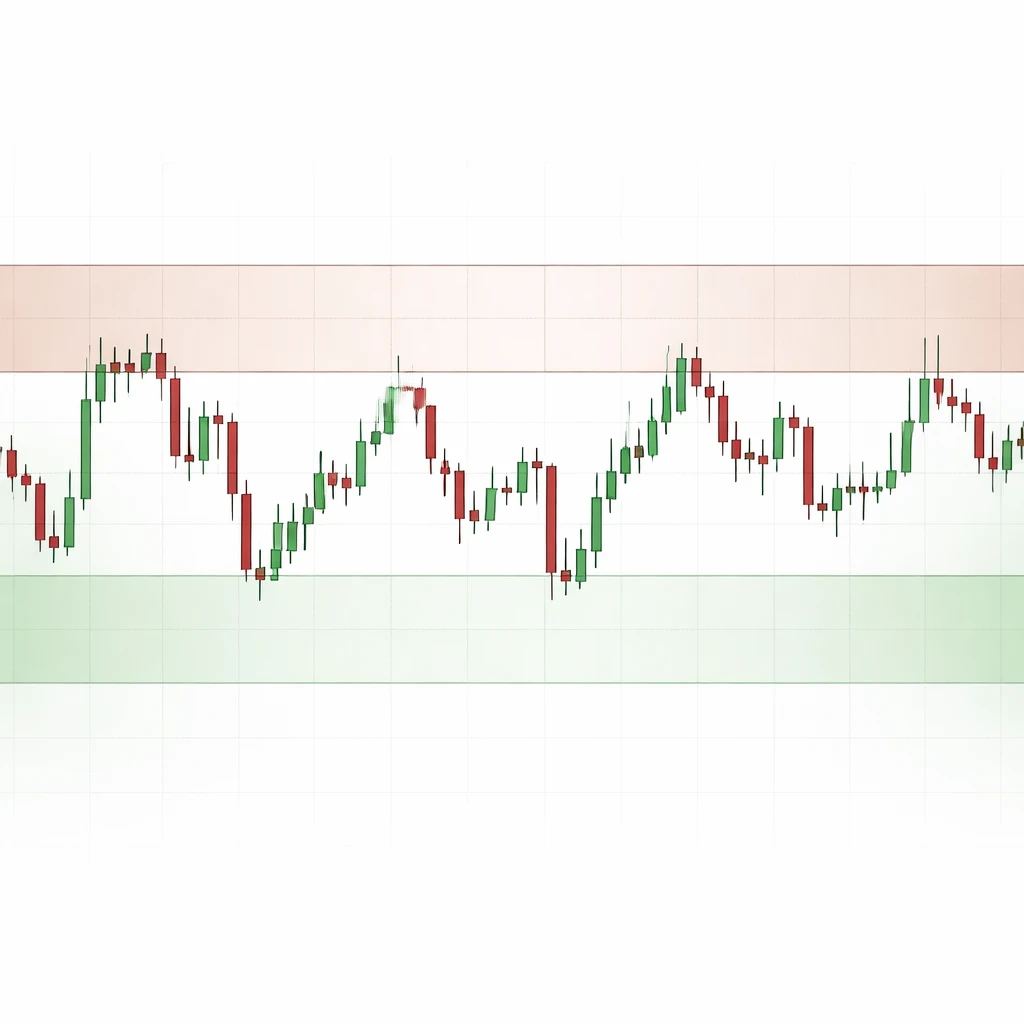
Ranging markets are periods in which price oscillates between relatively stable upper and lower boundaries without sustained directional follow through. During these phases, the relationship between potential loss and potential gain per decision is shaped by the geometry of the range as well as the microstructure of liquidity near its edges. Understanding risk and reward in a range is a risk management task before it is a trading task. It concerns the durability of capital across many attempts, not the outcome of a single trade.
Defining Risk and Reward in a Range
Risk and reward are often summarized as a ratio. The denominator is the loss if the position is invalidated. The numerator is the gain if the intended price path is realized. In a ranging environment, both sides of the ratio are bounded by the distance to the nearest structural feature. The most relevant features are the support and resistance levels that have contained recent swings, along with the volatility scale that measures how easily price fluctuates within that containment.
Consider three distances that exist at any decision point inside a range:
1. Distance to the nearest invalidation point inside or just beyond the range boundary, which informs risk per attempt.
2. Distance to a plausible profit-taking area that lies within the range, often nearer than the opposite boundary.
3. Distance to the opposite boundary if the mean reversion phase persists.
These distances are not constants. They vary as price moves across the range, and they drift with volatility. When price is near the center, the distance to either boundary is larger, but the distance to a sensible invalidation may also be large relative to typical noise. When price is near a boundary, the potential reward to the opposite side can appear attractive compared with a tight invalidation just outside the boundary, yet the risk of a regime switch or a breakout gap also increases. The risk/reward profile in a range is therefore conditional on location within the range and on the distribution of breakout risk.
Why Risk/Reward in Ranges Is Critical to Risk Control
Capital survives through sequences of outcomes, not through isolated wins. In a range, the path of outcomes can be choppy because price frequently reverses near the middle and intermittently overshoots at the edges. Without careful attention to the ratio between typical wins and typical losses, a sequence of small losses can accumulate faster than intermittent gains offset them.
The quantitative lens is expectancy. Suppose the average loss is defined as 1 unit of risk, and the average win is r units. If the probability of a win is p, the expected gain per attempt is p × r minus (1 − p) × 1. Positive expectancy requires the product of win rate and reward to exceed the expected loss. In a range, r is affected by the chosen target relative to range width, and p is affected by how often the range structure holds before a breakout or false move occurs. Traders often discover that r shrinks when targets are set conservatively within the range to avoid give-back, which raises the required win rate for sustainability.
Risk/reward in a range also influences variance of outcomes. A narrow target and a tight invalidation produce frequent small wins and losses. Variance of returns may be high because of frequent sampling of market noise. Conversely, a wider target toward the opposite boundary increases r but may reduce p and increase the chance of giving back unrealized gains as price oscillates. Both configurations can be viable or fragile depending on the market, but the key point is that survivability depends on whether the ratio between r and 1, together with p, is sufficient after costs and slippage.
Range Structure and Payoff Geometry
Ranges are not perfectly symmetric. Several structural features skew the risk/reward relationship:
Edge liquidity and false breaks. Liquidity often pools just beyond the boundary as orders cluster. This can produce brief excursions that sweep orders before price returns to the range. The implication is that invalidations tightly placed beyond the edge may be hit more frequently than a naive model assumes. That reduces the realized reward-to-risk ratio because losses occur at full size more often than anticipated.
Breakout gap risk. When the range eventually resolves, price can gap beyond nearby invalidation points. The loss realized is then larger than the planned 1 unit because of slippage. Outliers of this type tend to be one sided for a given position direction, which worsens the left tail of the payoff distribution and raises the risk of a deep drawdown.
Mean reversion decay. Inside the range, momentum tends to decay. The further price moves toward the center, the greater the chance that oscillation reduces unrealized gains before targets are met. This dynamic can decrease the average realized r unless exits are managed to capture a portion of the swing. Even without prescribing an exit rule, it is important to recognize that the geometry of oscillations reduces attainable reward relative to the theoretical distance to the opposite boundary.
Measurement Considerations Without Setups
Risk management begins with measurement that does not rely on specific entry rules. Several quantitative elements are useful when evaluating risk/reward in a range:
Range width and volatility scale. Estimate the distance between support and resistance that have contained recent swings. Complement this with a volatility measure, such as an average true range or a standard deviation of returns. The ratio of range width to volatility offers a simple gauge of how many typical fluctuations fit inside the range. A narrow range relative to volatility implies higher noise risk and tighter tolerances for invalidation distances.
Maximum favorable and adverse excursions. Distributions of how far price typically moves in favor of or against a position before reversing offer empirical bounds on potential r and 1. In ranging conditions, median favorable excursion may be modest, which puts pressure on achieving a favorable reward-to-risk ratio after costs.
Breakout frequency and magnitude. Historical episodes can be used to count how often a range structure broke and how far price moved when it did. Even if history is not predictive, this gives a baseline for tail risk. The payoff distribution in ranges is highly sensitive to the frequency of outsized adverse moves that exceed planned risk.
Transaction costs, spread, and financing. Costs reduce r and can inflate 1 when stops are close to the entry price. In a tight range, spread can consume a meaningful fraction of the intended move. Financing costs for leveraged or short positions also matter during prolonged holding periods.
How Risk/Reward Plays Out in Realistic Scenarios
To illustrate how the same range can yield different risk/reward profiles, consider three stylized scenarios. These are not prescriptions and do not embed timing or direction. They simply show how payoff geometry shifts with location and behavior of price within the range.
Scenario 1: Decisions Near the Midpoint
The middle of a range is convenient but often unfavorable to the ratio. Suppose the average distance to a sensible invalidation near the midpoint is 0.6 percent, and the distance to a conservative profit-taking level inside the range is 0.4 percent because of frequent mid-range reversals. If costs total 0.05 percent per round trip, the net reward-to-risk ratio is roughly (0.4 − 0.05) divided by 0.6, which is about 0.58. Even if the raw win rate around the midpoint is relatively high because price oscillates frequently, the expectancy margin is thin after costs. The sustainability of such a profile depends on whether the achievable win rate materially exceeds the breakeven threshold implied by r.
Another practical consideration near the midpoint is sequence risk. Rapid alternation in direction can produce clusters of losses if invalidations are close to entry. Clustering raises drawdown risk because many small losses can arrive within a short time window. Sequence risk does not change the long run expectancy, but it affects capital trajectory and the probability of breaching risk limits.
Scenario 2: Decisions Near a Boundary
Near the edges, the headline ratio can look attractive. Suppose the distance from a boundary to the opposite side of the range is 1.2 percent, while a tight invalidation just beyond the boundary is 0.3 percent. The gross ratio appears to be 4 to 1. Two complications often erode this figure.
First, false breaks can lift the realized loss. If brief excursions beyond the boundary occur with some frequency, the average loss may exceed the planned 0.3 percent because of slippage, partial fills, or spread widening at the moment of stress. Second, targets at the far edge may be difficult to achieve without interim reversals, which can result in partial gains or breakeven exits. The realized average reward could fall well below the theoretical 1.2 percent.
Despite these complications, decisions near the boundary can still have attractive payoff geometry when false break frequency is low and when realized favorable excursions are sufficient. The emphasis belongs on measured distributions rather than on the naive distance calculation.
Scenario 3: Range Resolution and Tail Risk
Eventually, ranges end. The termination can be orderly or abrupt. If it is abrupt, the realized loss in the final failed attempt may exceed the planned risk because price jumps through available liquidity. The payoff distribution in a ranging approach often includes a long tail of small gains and losses punctuated by a rare larger loss at regime change. Long term survivability requires that the cumulative small gains exceed this tail loss by a comfortable margin after costs. Measuring the size and frequency of tail events is central to judging whether the risk/reward architecture is robust.
Time, Decay, and the Cost of Waiting
Time affects both sides of the ratio. Within a range, expected waiting time to reach a distant target can be long relative to the variability of price. Waiting exposes capital to noise that can trigger invalidations. If holding costs exist, such as financing or borrow fees, they accumulate against reward. Even if costs are negligible, time decay matters because opportunity cost is real in any finite risk budget. If a position ties up risk capacity for an extended period with a modest expected r, the effective risk/reward of the overall process can deteriorate.
Some practitioners use time-based invalidations when price fails to progress. This converts stagnation into a bounded loss and reduces the variance of holding periods. Whether time-based invalidation improves expectancy in a given range depends on the pattern of oscillations and the costs incurred. The lesson for risk management is that time is embedded in risk/reward even when the ratio is presented as static numbers.
Position Sizing Interactions
Risk per attempt, often expressed as a percentage of capital, multiplies the consequences of the risk/reward profile. Consider two approaches with identical expectancy but different variance. The approach with higher variance will produce deeper drawdowns at the same risk per attempt. In ranges, high variance commonly arises from clustered small losses and occasional larger losses at break. If risk per attempt is large, these features can drive capital below risk limits before the positive expectancy manifests.
In practice, volatility-aware sizing reduces the chance that a typical adverse excursion consumes the entire planned risk in a single fluctuation. If the chosen invalidation is frequently reached by routine noise, realized loss distributions will be worse than planned. Sizing that respects the variability of price within the range can preserve the intended ratio. The objective is to align planned risk with the actual distribution of adverse movement, not to maximize nominal reward-to-risk on paper.
Common Misconceptions and Pitfalls
Misconception 1: A fixed 2 to 1 ratio guarantees profitability. A favorable nominal ratio does not ensure positive expectancy. Costs, slippage, and the true win rate matter. In ranges, frequent partial reversals can reduce realized reward, and false breaks can inflate realized loss. The realized ratio can be significantly lower than the planned ratio.
Misconception 2: Mid-range decisions are safer. Price may move less violently at the center, but the attainable reward is often smaller because nearby oscillations cap favorable excursion. After costs, the effective ratio can fall below 1 to 1, which implies a high required win rate for sustainability.
Misconception 3: The tighter the invalidation, the better. Tight invalidations inside a noisy range tend to be hit by routine fluctuations. The loss frequency rises and slippage can be proportionally larger relative to the small planned risk. The result is a degraded realized ratio and increased variance.
Misconception 4: Historical range width directly sets targets. Ranges breathe. Volatility can compress or expand, and structural levels can shift. Calibrating targets and invalidations purely to a past width can overfit local noise. When the range regime changes, the overfit parameters produce poor risk control.
Misconception 5: Correlation across attempts is negligible. In a tight range, successive decisions often share exposure to the same structural levels. Outcomes may be correlated, which intensifies drawdowns when the range fails. Counting attempts as independent can lead to underestimation of tail risk and overconfidence in the expected ratio.
Pitfall 1: Ignoring microstructure near edges. Spread can widen, depth can thin, and partial fills can occur at the most critical moments. The realized loss may exceed the planned risk more often than backtests suggest, especially if simulations assume perfect liquidity.
Pitfall 2: Averaging down within the range. Adding to a losing position because price remains within the historical band increases exposure just as breakout risk can be rising. The payoff distribution gains a heavier left tail, which undermines survivability even if average outcomes appear acceptable.
Pitfall 3: Overtrading noise. Ranges can tempt frequent decisions that aim to capture small moves. After costs, the net reward per attempt can shrink, while the number of attempts increases variance and operational complexity. A shallow ratio coupled with high frequency magnifies the impact of a single tail loss.
Pitfall 4: Misclassifying regimes. Treating a developing trend as a range produces asymmetric losses because invalidations placed close to the center are repeatedly breached. Static definitions of support and resistance that lag new information can aggravate this error.
Integrating Costs and Slippage Into the Ratio
Risk/reward is often presented without costs. In a ranging market, costs have an outsized impact because average move sizes are modest. A systematic adjustment is straightforward. If the planned reward is R and planned risk is 1, subtract expected round trip costs from R and add expected slippage to 1. The adjusted ratio then governs expectancy. In practice, the cost burden tends to be most severe near the midpoint where targets are small and turnover is high. Near the edges, slippage risk dominates during fast moves and potential breakouts.
It is helpful to build a simple ledger of realized and planned metrics. Record planned target distance, planned invalidation distance, estimated costs, and then record actual outcome. Over time, patterns emerge that reveal where the plan is consistently optimistic. Adjustments to the planning inputs can restore a realistic ratio and prevent drift into negative expectancy.
Drawdown Dynamics and Survivability
Long term survivability is not only about average expectancy. It is also about the worst path. In ranges, drawdowns commonly arise from a sequence of small losses around the midpoint or from a single larger loss at the regime break. The same average expectancy can produce very different drawdown profiles depending on how risk is concentrated around edges or spread across frequent small attempts.
Risk limits that cap loss over a period protect against the extreme left tail. From a risk/reward perspective, such limits force the process to respect the variability of outcomes, not just their average. If the risk budget is exhausted by many small losses inside the range, the process may miss the compensating wins that arise when the range delivers its typical oscillation. This is not an argument for loosening limits. It is an argument for aligning the planned ratio with the observed path behavior so that the risk budget is used efficiently.
Evaluation and Feedback Loops
Effective risk management in ranges benefits from a disciplined feedback loop:
Classify environments with simple rules. Even coarse classifications like range versus trend allow evaluation of whether the realized reward-to-risk differs by regime. The goal is not perfect prediction, but separation of performance figures so that ratio assumptions are tested where they apply.
Track MAE and MFE. Maximum adverse and favorable excursion statistics by regime show whether invalidations are aligned with noise and whether targets are reachable. If MAE routinely exceeds the planned risk inside the range, invalidations are too close to noise or slippage is undercounted.
Monitor tail events. Record outcomes around range terminations. These events often dominate long horizon results. Calibrating planned risk to the observed magnitude of breakouts helps prevent a single event from erasing many gains.
Reassess costs and liquidity. Market conditions change. Spreads and depth vary with time of day, news cycles, and volatility. Periodic recalibration of cost assumptions keeps the ratio grounded in current conditions.
What Mathematics Can and Cannot Deliver
Simple arithmetic supports planning, but it cannot remove structural uncertainty. A reward-to-risk of 3 to 1 does not guarantee safety if the true win probability is low or if outliers are mismeasured. Conversely, a sub 1 to 1 ratio can be viable if the win rate is high and tail risk is contained. The task in a ranging market is not to optimize a single ratio number but to understand the distribution of realized outcomes under that regime and to align risk per attempt with that distribution.
Model uncertainty is a central limitation. Ranges lack universal definitions. Any algorithm that marks support and resistance uses parameters that may fit recent noise. This creates an optimistic bias in backtests. Guarding against this bias involves out-of-sample evaluation, modest parameter sensitivity, and humility regarding expected r and p.
Putting It All Together for Capital Protection
Risk/reward in ranges is about sustainable arithmetic under a specific market geometry. The environment influences both the numerator and denominator of the ratio through volatility, liquidity near edges, and the oscillatory path of price. Costs and slippage compress realized reward and expand realized risk. Tail events at range resolution tend to dominate long horizon results. A process that acknowledges these features and measures them explicitly is more likely to preserve capital through the inevitable sequences of small setbacks and occasional outliers that characterize ranging markets.
Key Takeaways
- In ranging markets, risk and reward are functions of location within the range, volatility scale, and the likelihood of false breaks and regime shifts.
- Nominal reward-to-risk ratios often overstate reality once costs, slippage, and partial reversals are accounted for.
- Expectancy depends on both the ratio and the win rate, and in ranges the win rate can be sensitive to microstructure noise and edge behavior.
- Tail losses at range termination can erase many small gains, so measuring breakout frequency and magnitude is essential for survivability.
- Continuous measurement of realized versus planned distances, costs, and excursions helps align the risk/reward framework with actual market behavior.