
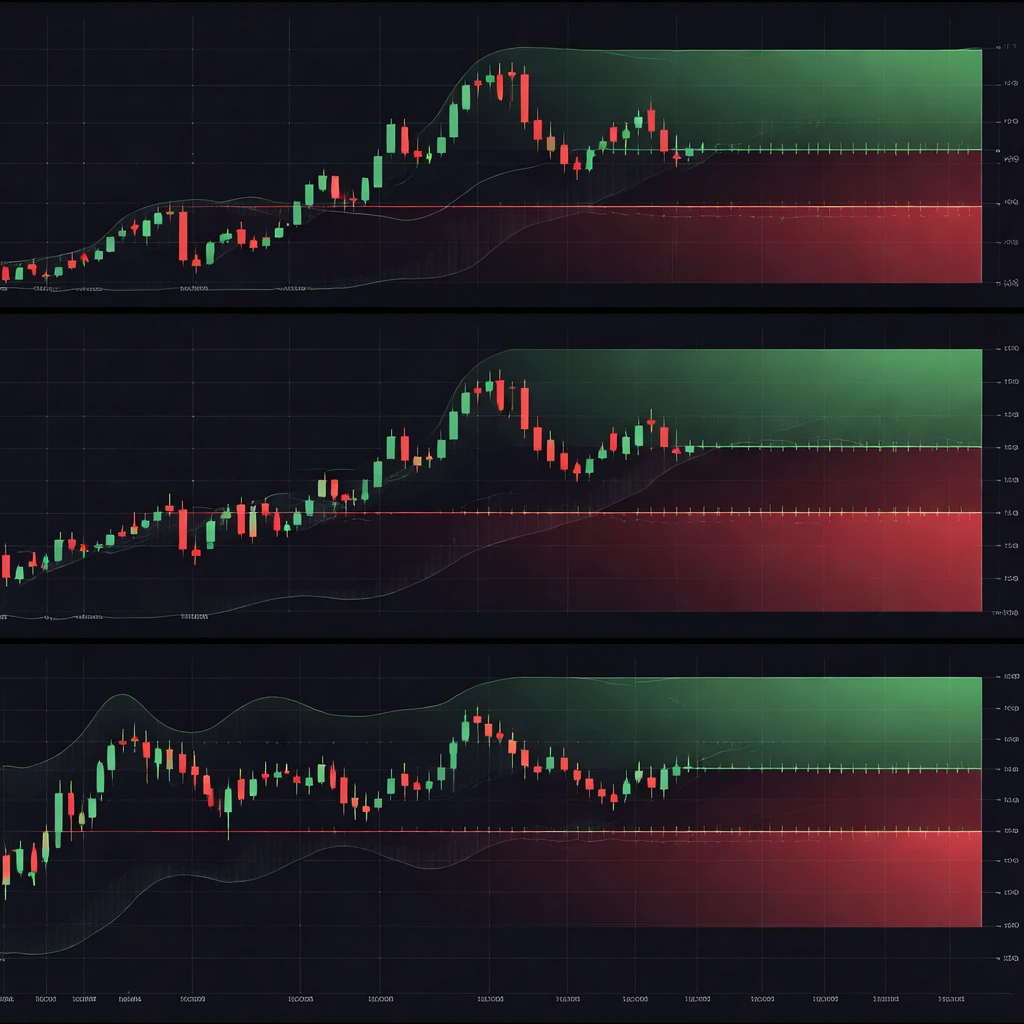
Risk management is not only a question of how much to risk on a single position. It is also a question of how risk and reward change with the timeframe used to form the thesis, to execute the trade, and to manage the position. Risk/Reward Across Timeframes refers to the discipline of defining, measuring, and comparing risk and prospective reward on consistent terms when different horizons are involved, from minutes to months. The objective is to protect capital and preserve long-term survivability by avoiding silent mismatches between the timeframe of the idea and the timeframe of the risk taken.
Defining Risk/Reward Across Timeframes
At its core, risk/reward is the ratio between potential loss and potential gain for a specific position. Across timeframes, the idea extends to a layered view of exposure. The same price chart may look favorable on a five-minute window, ambiguous on a four-hour window, and constrained on a weekly window. Each horizon implies different stop placement, different target plausibility, and different risks such as overnight gaps or event exposure. Risk/Reward Across Timeframes requires that the trader explicitly anchor risk, reward, and holding period to a chosen timeframe and respect that choice from entry through exit.
Three layers show up repeatedly in practice:
- Thesis timeframe: The horizon over which the core idea is expected to play out. It might be intraday, multi-day, or multi-month.
- Execution timeframe: The lower or equal timeframe used to time entries and exits, often for precision and cost control.
- Account timeframe: The long-run horizon of the capital base. It includes aggregation of risks across positions, drawdowns, and survivability over quarters and years.
Confusing these layers produces distorted risk/reward. A trade conceived on a daily chart but executed with a five-minute stop is often under-risked relative to the thesis and easily shaken out by noise. The opposite problem also occurs. A quick intraday idea that drifts into a multi-day hold without re-evaluating risk and new sources of uncertainty can expand downside in ways not accounted for at entry.
Why Timeframe Alignment Is Critical to Risk Control
Survivability depends on managing the size and duration of risk as a coherent bundle. Time increases exposure to hazards that are either negligible or absent on short horizons. Examples include overnight gaps, illiquidity at the open, macro announcements, and weekend event risk. A position that looks attractive on a short timeframe may have a modest stop distance and an apparently high reward multiple, but if it is held beyond the intended window the distribution of outcomes changes. The trade now competes with risks that do not scale linearly with time.
Capital protection is not only about the magnitude of losses. It also involves the frequency and clustering of losses. Many short-lived trades with small risk per trade may reduce the likelihood of large single-event losses. Fewer trades held for longer may concentrate risk into fewer but larger exposures. Neither approach is inherently better. What matters is that risk and reward are evaluated on consistent terms for the chosen timeframe, so that position sizing, stop placement, and expectations of variance align with that horizon.
Drawdown math further illustrates the point. A 20 percent loss requires a 25 percent gain to recover to the previous equity high. If a trader unintentionally migrates from an intraday plan to a multi-day hold during a volatile period, the downside tail can widen. This increases the chance of deeper drawdowns that take longer to repair and place compounding at risk. Aligning risk/reward with timeframes reduces the probability of oversized setbacks driven by mismatch rather than by idea quality.
Measuring Risk and Reward Consistently
A common unit for risk is R, defined as the planned loss per share or contract if the stop is reached, multiplied by position size, then normalized by account risk per trade. A trade that gains two times its initial risk is a 2R winner. This normalization is valuable across timeframes. It allows the comparison of an intraday 0.4 percent stop to a swing 3 percent stop on equal footing at the account level.
Across timeframes, two complications arise:
- Stop logic differs. A microstructure-based stop intended for intraday noise bands is not interchangeable with a daily-chart stop designed to survive multi-day swings. A 3R target on a five-minute chart may sit inside a single daily candle, which reshapes the probability of reaching that target before invalidation.
- Reward pathways differ. Intraday moves often unfold through continuous trading with small gaps. Multi-day moves include discontinuities at opens and over weekends. The path to a 2R gain can include overnight gaps that bypass exit plans, both favorable and unfavorable.
Because of these differences, the same price levels can produce very different risk/reward distributions depending on how long the position is expected to be held. A disciplined process ties the unit of risk to the thesis timeframe, then uses execution tactics that serve the thesis rather than override it.
Time at Risk and Exposure Density
Risk is not only a function of distance to stop. It is also a function of time held. A useful mental model is exposure density: expected return per unit of time at risk, conditioned on the timeframe. Two trades might both target 2R. One is expected to resolve within 90 minutes during liquid hours. The other is expected to resolve over six trading days and includes two overnights and a weekend. Even with the same nominal R multiple, the second trade carries different hazards, and its expected dispersion of outcomes is broader. Exposure density helps explain why mixing timeframes without planning can degrade overall results. It shifts the risk budget toward hazards that were not priced into the original idea.
Applying the Concept to Real Trading Scenarios
Example 1: Intraday thesis with intraday management
Suppose a trader identifies an intraday momentum continuation pattern after a liquidation event. The stop is placed 0.3 percent below a local structure. The target is 0.9 percent above entry. The ratio is 3 to 1 in intraday terms and the average hold time in the record for similar patterns is under one hour. In this context, the trade’s risk and reward are defined within the intraday environment. Liquidity is high, slippage is often small, and overnight risk does not apply. The thesis timeframe, execution tactics, and management rules are aligned, so the resulting risk statistics describe the actual distribution the account will experience.
Example 2: Daily thesis with intraday execution
Consider a medium-horizon trend continuation idea on the daily chart. The invalidation is 3 percent below entry, which defines 1R. The trader chooses an intraday pullback to refine timing, but the risk is still measured from the daily invalidation, not from a five-minute swing. The expected hold time is multiple days. The reward path includes overnight gaps and potential announcements. Here, intraday execution seeks a better entry price, but it does not compress the true risk. By judging outcomes in daily R units rather than intraday R units, the trader preserves consistency and avoids overstating the reward multiple.
Example 3: Intraday thesis that becomes a multi-day hold
Assume an intraday idea that fails to reach the target before the close. The trader decides to hold overnight, hoping for continuation. The moment this decision is made, the risk profile changes. Gap risk is now relevant. The intraday stop is not designed to survive overnight volatility, so the distance to a realistic multi-day invalidation is likely wider. Measuring the trade in intraday R units is now misleading. The correct approach is to re-define the thesis timeframe, re-specify invalidation on that timeframe, and recognize that the reward multiple is recalibrated as well. Without this step, apparent risk/reward can be overstated and capital exposed to unpriced hazards.
How Timeframes Interact With Market Structure
Market structure has a hierarchical character. A clean trend on a five-minute chart can live inside a choppy, range-bound four-hour structure. If a short-horizon trade targets a move that runs into a well-defined higher timeframe resistance, the prospective reward shrinks in practice even if the intraday chart shows open space. Conversely, a noisy lower timeframe can obscure a strong higher timeframe trend that improves the odds of a multi-day idea. Risk/Reward Across Timeframes is therefore not only about stop and target mechanics. It is also about mapping the micro thesis to the larger structural context and acknowledging where higher timeframe levels may truncate reward or expand risk.
Capital Protection and Long-Term Survivability
Long-term survivability depends on keeping the account in business across many independent decisions. Three elements connect timeframe discipline to survivability:
- Containment of tail risk: Holding positions through periods that include event risk naturally increases the chance of outsized adverse moves. When these larger losses occur, they can erase gains earned through numerous short-horizon trades. Consistent timeframe alignment keeps tail exposure in proportion to the thesis.
- Control of variance: Equity curves are driven by the variance of outcomes as much as by the average return. Misaligned timeframes introduce variance that the trader did not intend to buy. This variance raises the probability of deeper drawdowns and harms compounding.
- Risk budgeting over time: An annual risk budget can be exhausted quickly if timeframe drift causes positions to carry risk longer than planned. When exposure persists without a thesis-based reason, unused risk accumulates silently and reduces flexibility for new opportunities.
The combination of these elements often explains why traders with apparently sound entries still suffer unstable results. The problem is not the signal. It is the unresolved conflict between idea horizon, holding period, and the statistics used to evaluate outcomes.
Common Misconceptions and Pitfalls
Misconception 1: An R multiple is universal across timeframes
Reality: A 2R result defined by a five-minute stop is not equivalent to a 2R result defined by a daily stop. The denominators differ. Without a consistent reference unit tied to the thesis timeframe, performance metrics become incomparable and can mislead risk decisions.
Misconception 2: Tighter stops always improve risk/reward
Reality: Tighter stops can improve nominal R, but only if the stop is placed where the thesis would be invalidated in that timeframe. A very tight stop on a daily thesis may increase the likelihood of being stopped by noise while the higher timeframe thesis remains intact. This converts what should be one trade into multiple small losses without altering the true probability of the idea.
Misconception 3: Execution timeframe determines the risk
Reality: Execution timing and risk measurement are different functions. The execution timeframe can refine entries, but the risk should be measured where the idea fails. Reducing risk to the execution timeframe introduces a structural mismatch between the thesis and the stop logic.
Misconception 4: Holding longer always increases reward potential
Reality: Holding longer exposes the trade to new sources of uncertainty such as gaps and scheduled events. Potential reward sometimes increases, but so does the tail of the loss distribution. If the thesis was intraday, extending the hold converts the trade into a different instrument with different risks.
Misconception 5: Higher timeframe context can be ignored
Reality: Reward is often capped by higher timeframe levels or volatility regimes. Ignoring them can bias estimates of upside while leaving downside intact. Awareness of context is part of measuring risk/reward on realistic terms.
Practical Workflow for Timeframe-Consistent Analysis
A structured workflow reduces the chance of timeframe drift:
- Specify the thesis timeframe: State the horizon for the idea and the conditions that would invalidate it. Define stop logic around that invalidation, not around short-horizon noise.
- Choose the execution timeframe: Use a lower timeframe only to improve location or reduce cost. Confirm that execution choices do not tighten the stop beyond thesis invalidation without analytic justification.
- Define risk in account terms: Translate the stop distance into account-level R. Size the position with respect to that R. This keeps results directly comparable across ideas and horizons.
- Map the higher timeframe: Identify major levels, volatility regime, and event calendar relevant to the holding period. If the expected hold crosses an event, acknowledge how this affects both risk and reward distribution.
- Pre-commit management actions by time: Decide what happens if the trade is unresolved by the end of the thesis horizon. If the plan allows carrying beyond the original horizon, specify the new invalidation and the new risk unit in advance.
Analytics That Help
Relevant metrics extend beyond win rate and average R. The following measures illuminate how risk/reward behaves across time:
- Hold-time distribution: The empirical distribution of holding periods by setup. It reveals whether a trade type routinely overstays its intended horizon.
- Maximum adverse excursion by timeframe: The largest drawdown from entry before either stop or target is reached, categorized by thesis timeframe. This shows whether stop logic is consistent with underlying volatility.
- Overnight and weekend outcome segments: Separate the performance of positions carried through closes from those closed intraday. Different tails often emerge.
- Event-crossing filter: Performance when trades cross scheduled announcements compared with when they do not. This highlights how much of the distribution shift is driven by known calendar events.
- R per hour or R per day at risk: A rough exposure density measure. It should be interpreted cautiously, but it helps compare how efficiently different horizons convert time at risk into realized R.
Position Sizing Across Timeframes
Position sizing is the bridge between idea quality and account survivability. When the risk unit is based on the thesis timeframe, sizing remains consistent even if entry tactics vary. Problems arise when positions are sized using an execution-level stop for a thesis that belongs to a higher timeframe. The position then appears small relative to the higher timeframe invalidation, which encourages either oversized positions or premature exits. Both alternatives degrade results.
Another sizing issue occurs when short-horizon ideas are allowed to morph into long-horizon holds after partial unrealized losses. This changes the denominator of R on the fly. Without a planned reframe, sizing no longer matches risk. The account absorbs a level of tail risk that would not have been chosen upfront.
Regime Shifts and Timeframe Sensitivity
Volatility regimes alter the relationship between time and risk. In quiet regimes, daily ranges contract and intraday setups may capture a significant fraction of the day’s move. Holding multi-day positions may involve relatively smooth paths. In volatile regimes, the opposite is true. Intraday noise expands, daily bars often engulf short-term targets, and overnight gaps become larger and more frequent. The same nominal target and stop can have very different odds across regimes. Recognizing the regime that corresponds to the thesis timeframe is part of realistic risk/reward estimation.
Correlation and Portfolio Level Timeframes
Most discussions focus on a single trade, but timeframes also affect the portfolio. If several positions share the same thesis horizon and are likely to respond to the same events, their risks are correlated. A news shock can impact all of them within the same holding window. The effective risk is then larger than the sum of individual Rs. Diversifying across timeframes can, in some cases, diversify event exposure. That said, the same alignment principle applies. Each position’s risk/reward should be measured on its own thesis timeframe, and only then aggregated at the account level with correlations in mind.
Behavioral Risks Linked to Timeframes
Timeframe inconsistency is a frequent behavioral trap. Faced with discomfort, traders often change the rules of the game mid-trade. A short-term loss becomes a long-term investment. A medium-term thesis is micromanaged on a one-minute chart. These shifts usually occur without a new analysis of invalidation and reward potential. The result is chronic overtrading when fearful and prolonged holding when hopeful. Both behaviors disconnect realized outcomes from the statistics that the plan was built on.
A practical antidote is to label every trade by thesis timeframe in the journal before entry, then evaluate execution decisions against that label. If the label changes, the plan should record the new invalidation, the new risk unit, and the reason for the change. This habit maintains integrity between risk measurement and actual behavior.
Putting It Together in Realistic Terms
Risk/Reward Across Timeframes is not about complexity for its own sake. It is about consistency. A well-specified trade links three elements: a thesis with a defined horizon and invalidation, an execution method that serves the thesis, and an account-level risk unit that expresses the loss if wrong. Once set, those elements imply a reward profile conditioned on time at risk and the market structure that lies between entry and target. If the horizon changes, the plan changes with it, including a re-specified stop and a re-evaluated reward path. If the structure on a higher timeframe contradicts the expected reward, the trade’s attractiveness is revised before entry rather than after losses accrue.
In practice, the most durable records often reflect an unremarkable virtue. The trader consistently measures risk and reward on the same timeframe that supports the thesis and leaves the execution timeframe to do its proper job: controlling entry cost without redefining what risk means. This discipline keeps drawdowns within planned bounds and allows the compounding of many independent, like-for-like decisions over time.
Key Takeaways
- Risk/Reward Across Timeframes means measuring risk and potential reward on the same horizon as the trade thesis, not on the execution timeframe.
- Time held is a risk dimension. Overnight and event exposure change the distribution of outcomes even when price levels are unchanged.
- R multiples are only comparable when the denominator is tied to the thesis timeframe and maintained from entry through exit.
- Timeframe drift increases variance and tail risk, which threatens capital preservation and long-term survivability.
- A practical workflow labels the thesis timeframe, maps higher timeframe context, sizes in account-level R, and pre-commits actions if the trade outlives its intended horizon.