
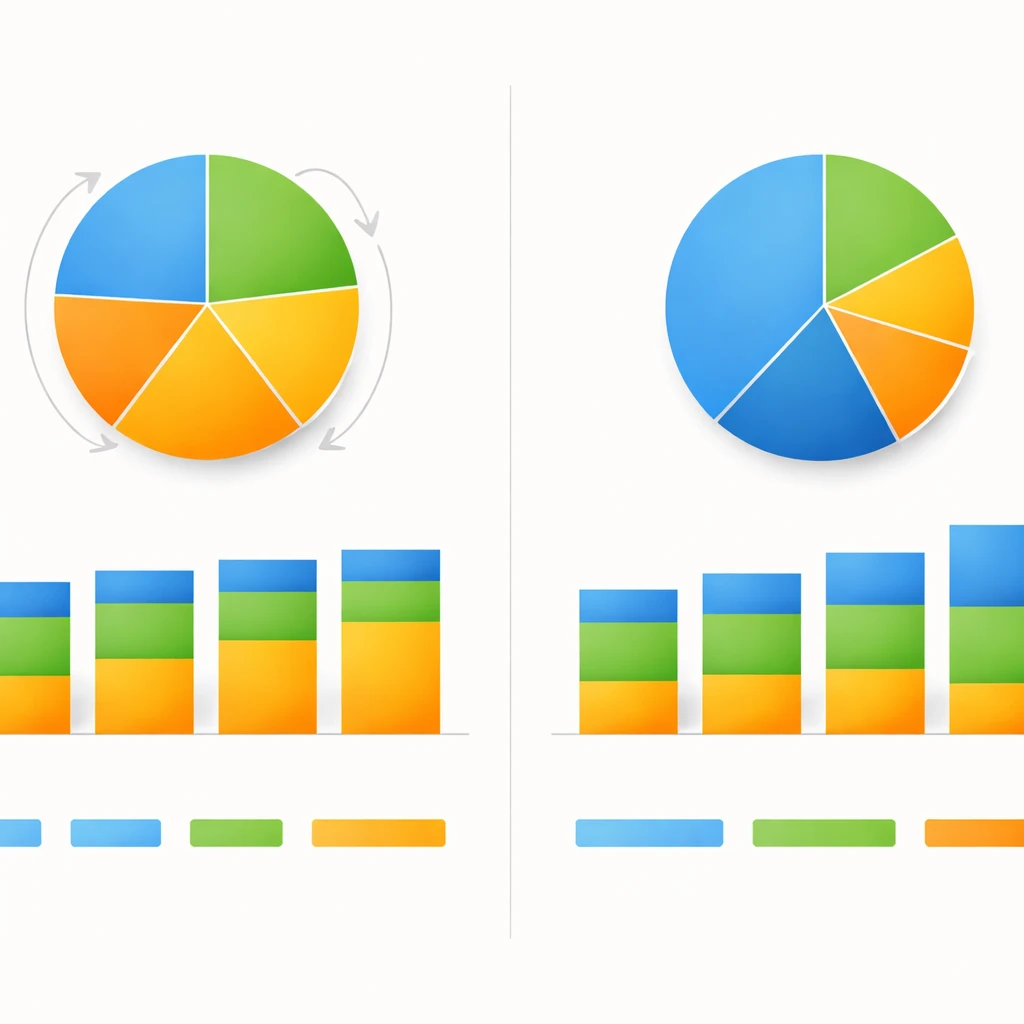
Portfolio construction is not only about what assets to hold. It is also about how those holdings evolve as markets move. The debate between rebalancing and letting winners run speaks to a central design choice in long-horizon investing. On one side, rebalancing restores a portfolio to predefined target weights. On the other, letting winners run allows allocation weights to drift with performance. Both approaches have a coherent internal logic, and each can be implemented with discipline. Understanding their mechanics, trade-offs, and interactions with long-term capital planning helps investors and fiduciaries structure resilient portfolios.
Defining the Two Approaches
Rebalancing is the process of bringing a portfolio back to specified target weights after market movements cause drifts. Weight targets are usually grounded in a policy allocation that reflects a chosen risk profile, liquidity needs, and time horizon. Rebalancing can occur on a calendar schedule, when deviations exceed tolerance bands, or by using new cash flows to offset drifts. In each case, the action reduces exposure to recently outperforming assets and increases exposure to underperforming assets relative to the policy weights.
Letting winners run means allowing allocations to drift as asset prices change. In this approach the portfolio does not automatically sell outperformers or buy underperformers solely to restore targets. Drift is permitted so that the portfolio captures extended trends or momentum in assets that have performed well. Some practitioners still monitor concentration risk and set broad guardrails, but the core idea is to minimize forced trades that counter prevailing trends.
How the Choice Operates at the Portfolio Level
At the portfolio level, the rebalancing decision governs three core dimensions: effective risk exposure as prices move, concentration risk in outperforming segments, and the realized sequence of returns over time. The decision is not primarily about picking assets. It is about managing the evolving weight of each chosen asset class, region, sector, or factor.
Consider a simple two-asset policy allocation of 60 percent global equities and 40 percent high-quality bonds. If equities rally while bonds are flat, the equity weight rises above 60 percent. A rebalancing policy would sell some equities and buy bonds to return to 60 percent. A let-winners-run policy would hold the new higher equity weight. When the next period arrives, the two portfolios face different risk and return paths because they now hold different effective exposures.
Over many periods, these mechanics shape the portfolio’s behavior. Rebalancing tends to maintain a risk profile closer to the original policy. Letting winners run permits the risk profile to migrate toward whatever has performed best recently. In addition, rebalancing often introduces a contrarian tilt, since it sells recent winners and adds to laggards. Letting winners run tilts the portfolio toward momentum, since the most successful assets become larger weights.
Why the Concept Matters for Long-Term Capital Planning
Long-term capital planning involves translating objectives and constraints into a feasible path for funding future liabilities and spending needs. The rebalancing choice affects that path in several ways.
- Risk control and spending stability. If a plan’s capacity to absorb drawdowns is limited, maintaining exposures near policy targets can help keep volatility closer to the level assumed in planning models. Unchecked drift toward a single outperforming asset class can raise the probability and potential depth of future drawdowns if leadership reverses.
- Sequence risk. The order of returns can matter greatly when there are contributions or withdrawals. A portfolio that drifts toward a volatile asset near a downturn can experience larger early losses, which can be difficult to recover when withdrawals are ongoing.
- Compounding and volatility. Volatility affects compound growth through arithmetic. For a given average return, higher volatility can reduce the geometric return. By moderating allocation swings, rebalancing may influence this relationship, although the effect depends on asset correlations and market regimes.
- Governance and discipline. Institutions often adopt a policy allocation with defined risk budgets and tracking error limits. Rebalancing is the mechanism that enforces those policies. Letting winners run can also be disciplined if it is bounded by explicit concentration or risk constraints.
- Costs and taxes. Trading incurs explicit costs and, in taxable accounts, can realize gains and losses. Rebalancing frequency and method change these outcomes. Letting winners run may reduce turnover initially but can lead to larger eventual trades if concentrations later need to be reduced.
Mechanics of Rebalancing
Rebalancing methods vary in timing, thresholds, and funding sources. The methods are implementation choices rather than prescriptions of what an investor should do.
- Calendar-based. Trades occur at set intervals, such as quarterly or annually. This is straightforward and predictable but can be indifferent to whether drifts are small or large.
- Threshold-based. Trades occur only when weights drift beyond tolerance bands. Bands can be defined as plus or minus a fixed number of percentage points from target, or as a percentage of target weight. This approach links trading to the economic size of the drift.
- Range rebalancing. Weights are allowed to float within a range. Rebalancing to the edge of the range rather than to the exact target can reduce turnover while maintaining control.
- Cash-flow rebalancing. New contributions or withdrawals are used to push the portfolio toward targets without additional trading. This can be tax and cost aware, though the degree of correction depends on the size of flows.
Each method expresses a different balance between tracking the policy allocation closely and minimizing trading. The choice of method is part of overall portfolio design and should be consistent with the role of each asset class in the portfolio.
Mechanics of Letting Winners Run
Letting winners run does not imply a lack of discipline. It means that the default action after outperformance is to allow the higher weight to persist. Many implementations include basic safeguards.
- Concentration limits. A hard cap can be placed on an asset class, sector, or single position to bound tail risk from dominance by one component.
- Risk budgeting. Exposures can be monitored so that volatility or value-at-risk remains within defined parameters even as weights drift.
- Periodic review without forced trades. Drift is assessed at set intervals, but trades are only made if concentrations threaten stated constraints, liquidity needs, or counterparty limits.
With these measures, letting winners run functions as a momentum-respecting allocation approach that seeks to maintain exposure to persistent trends while managing the most acute concentration risks.
Illustrative Numerical Examples
Simple numerical examples clarify how outcomes can diverge. Suppose a portfolio begins at 60 percent equities and 40 percent bonds with a total value of 1,000,000. Equities gain 20 percent and bonds return 0 percent in year one. The portfolio rises to 1,120,000. The new weights are roughly 64.3 percent equities and 35.7 percent bonds.
Case A: Rebalance to 60 percent at the end of year one. That implies 672,000 in equities and 448,000 in bonds.
Case B: Do not rebalance and let winners run into year two. That leaves 720,000 in equities and 400,000 in bonds.
Now consider two alternative year-two scenarios:
- Scenario 1, reversal. Equities decline by 10 percent and bonds gain 5 percent. Case A ends year two at 604,800 in equities and 470,400 in bonds for a total of 1,075,200. Case B ends at 648,000 in equities and 420,000 in bonds for a total of 1,068,000. With a reversal, the rebalanced portfolio does slightly better because it carried less equity into the decline and more bonds into the gain.
- Scenario 2, continuation. Equities gain 10 percent and bonds return 0 percent. Case A ends at 739,200 in equities and 448,000 in bonds for 1,187,200. Case B ends at 792,000 in equities and 400,000 in bonds for 1,192,000. With continuation, the portfolio that let winners run does slightly better because it maintained higher equity exposure during the further rally.
These examples are deliberately simple, but they illustrate that rebalancing can help when returns mean revert, and letting winners run can help when returns trend. Real markets cycle through a mix of both behaviors, with strength and duration that vary by asset class and period.
When Rebalancing Tends to Help
Rebalancing is often associated with benefits in environments where diversification works through imperfectly correlated assets that oscillate in leadership. Several mechanisms can contribute:
- Mean reversion across assets. If the relative performance of assets tends to revert, systematically trimming outperformers and adding to underperformers can harvest that pattern.
- Risk stabilization. Keeping exposures near targets helps maintain the intended volatility profile. This can reduce the risk of a drift-driven drawdown that challenges spending plans or risk limits.
- Governance alignment. Many policy documents, especially for institutions, define explicit allocation ranges. Rebalancing is the way the portfolio remains aligned with those policies.
These potential benefits depend on the correlation structure of the chosen assets, the cost of trading, and the size of tolerances. They are not guaranteed and can be diluted by high turnover or taxes.
When Letting Winners Run Tends to Help
Letting winners run can be advantageous when strong momentum or structural trends dominate returns. In such periods, frequent trimming of outperformers can reduce participation in the leading assets. Allowing drift intentionally keeps exposure aligned with observed leadership for longer.
However, drift can also increase concentration risk, especially if the winner is volatile or if correlation spikes during stress. Implementations that allow drift but set explicit concentration caps are designed to balance trend participation with risk containment. The trade-off is between potential foregone gains from trimming too early and potential larger losses if leadership reverses after weights have grown substantially.
The Role of Correlation Regimes
Correlation regimes shape how much rebalancing can harvest. When assets are imperfectly correlated and leadership rotates, rebalancing moves capital toward the laggard that later catches up. If cross-asset correlations rise and stay high, diversification benefits shrink and rebalancing transfers capital among assets that may move together. In that setting, the primary function of rebalancing becomes risk control rather than return enhancement.
Correlation patterns can also change within equities across geographies, sectors, or styles. A portfolio that lets winners run within a set of highly correlated assets may unintentionally concentrate in a single factor or theme. Monitoring not only asset class weights but also factor exposures helps avoid hidden concentrations.
Costs, Taxes, and Frictions
Practical implementation requires respect for frictions. Every trade has potential explicit costs, market impact, and in taxable accounts, tax consequences. The frequency and size of rebalancing trades influence all three. Cash-flow rebalancing, tolerance bands, and partial rebalancing to the edge of a range are tools used to reduce turnover while maintaining alignment with policy weights.
Letting winners run often results in lower turnover early in a trend, but if concentrations later need to be reduced for risk reasons, larger trades can be required at that time. In taxable settings, those later trades may crystallize substantial gains. The timing of realization therefore interacts with capital planning considerations such as annual budgets, spending needs, and the availability of offsetting losses.
Behavioral and Governance Considerations
Even well-designed policies can fail in practice if they are not behaviorally sustainable. Rebalancing requires purchasing assets that have recently disappointed and trimming assets that have recently excelled, which can be psychologically uncomfortable. Letting winners run requires tolerating growing concentration, which can also be uncomfortable, especially near market peaks.
Clear rules, role definitions, and documentation help create governance that is robust under stress. For institutions, this can take the form of policy ranges, escalation processes when drifts exceed ranges, and pre-agreed rebalancing procedures. For individuals, it can involve automated rules or delegation to a manager that executes according to a mandate. The common thread is to reduce reliance on ad hoc judgment during volatile periods.
Real-World Portfolio Contexts
Institutional endowments and foundations. Many set strategic policy weights across equities, bonds, real assets, and alternatives. Policy rebalancing is a primary tool for staying within risk and liquidity constraints. Cash flows from contributions and spending often support incremental rebalancing with limited trading. In some cases, committees allow measured drift within defined ranges to capture trend persistence without breaking policy limits.
Defined benefit pension plans. Liability-driven investment frameworks often specify a growth portfolio and a liability-hedging portfolio. Rebalancing maintains the intended hedge ratio and growth allocation relative to funded status. Allowing drift can influence the funded status trajectory by altering the balance between return seeking and liability matching.
Individual long-horizon savers. In tax-advantaged accounts, periodic rebalancing can be implemented with fewer tax frictions. In taxable accounts, some use cash inflows, dividend reinvestment choices, or tolerance bands to manage turnover. Others may accept drift in parts of the portfolio to keep realized gains lower, subject to explicit concentration limits.
Multi-manager and factor portfolios. Within equity sleeves, weights can drift toward factors such as growth, value, or quality depending on market leadership. Rebalancing to factor targets helps control unintended tilts. Letting factor winners run can increase exposure to prevailing themes, which may be desirable or undesirable depending on the role of the sleeve relative to the total portfolio.
Stress Events and Path Dependency
Stress episodes reveal how these approaches behave under pressure. In rapidly falling markets, portfolios that had drifted toward riskier assets often experience larger peak-to-trough drawdowns. Rebalancing into declining assets during a selloff can appear counterintuitive at the time, but if prices later recover, those trades can add value by reestablishing exposures at lower levels. Conversely, in strong recoveries or extended bull markets, portfolios that allowed winners to run can realize higher interim and sometimes higher long-term returns if the trend persists longer than expected.
Path dependency means the sequence of gains and losses interacts with rebalancing decisions. A portfolio that rebalanced early in a trend might lag for many periods, then catch up when leadership rotates. Another that allowed drift might lead for a time and then give up relative gains after a reversal. The elasticity of this lead-lag effect depends on how wide the tolerance bands are, how frequently reviews occur, and how correlated the portfolio components are.
Measuring and Monitoring
Effective oversight requires systematic measurement. Several tools are widely used to assess whether a chosen approach is performing its intended function.
- Drift reports. Regular reports quantify deviations of current weights from policy targets or ranges. These identify where action might be required under predefined rules.
- Tracking error to policy. A statistical measure of the volatility of the difference between the portfolio and its policy benchmark. Higher tracking error may be acceptable when drift is intentional but should be monitored relative to governance limits.
- Scenario analysis. Historical and hypothetical scenarios can be used to estimate portfolio behavior under different return patterns, including cases that favor rebalancing and cases that favor letting winners run.
- Risk decomposition. Breaking down total risk by asset class, sector, or factor reveals whether drift is increasing exposure to a small set of risks.
Designing Guardrails Without Making Predictions
Neither rebalancing nor letting winners run requires predicting the next market move. The design problem is to align the approach with the portfolio’s objectives, constraints, and tolerance for concentration.
- Articulate the role of each sleeve. For example, a defensive sleeve might be maintained close to policy with narrow ranges, while a growth sleeve might be permitted wider drift within concentration caps.
- Select a trigger logic. Calendar checks ensure regular discipline. Thresholds tie trades to the economic significance of drift. Range rules can reduce turnover while still constraining risk.
- Integrate costs and taxes. Cash-flow rebalancing and partial rebalancing to range edges can reduce trading frequency. Tax-aware lot selection can influence after-tax outcomes in taxable settings.
- Define maximum concentrations and risk limits. Hard stops on single positions, sectors, or asset classes prevent extreme drift that can dominate outcomes.
Putting the Concepts in a Broader Diversification Context
Rebalancing and letting winners run operate within the broader logic of diversification. The first reinforces diversification by reallocating toward the policy mix. The second relaxes diversification over time in favor of alignment with recent leadership. Neither approach is inherently superior across all environments. Their effectiveness depends on market structure, asset correlations, the persistence of trends, and implementation frictions.
For example, in a period where equities and bonds are negatively correlated and alternate leadership, rebalancing between them can stabilize volatility and may capture mean reversion. In a prolonged equity-led expansion with falling rates and strong earnings growth, allowing equity weights to rise could dominate for a time. The uncertainty about which regime will prevail argues for rules that are clear about when to trade, how much drift is acceptable, and how costs are managed, rather than for overconfidence in any single pattern of returns.
An Extended Practical Context
Imagine a diversified portfolio spanning global equities, high-quality bonds, inflation-linked bonds, and a real assets sleeve. A policy could set 50 percent equities, 30 percent nominal bonds, 10 percent inflation-linked bonds, and 10 percent real assets. Over a three-year period, suppose equities compound strongly, nominal bonds are flat, inflation-linked bonds rise modestly after an inflation surprise, and real assets rally in the first year then stall. Without rebalancing, equity weights can climb well above 50 percent, and the inflation-linked sleeve might become a smaller fraction just as inflation risk remains nontrivial.
Regular rebalancing in that context keeps the allocation closer to the original intent of balancing growth and inflation protection. Allowing winners to run increases the growth tilt and reduces diversification benefits. Neither approach changes the underlying performance of the assets themselves, but the allocation choice changes how the total portfolio experiences that performance and how it absorbs shocks that arrive later.
The same logic appears in equity-only portfolios split across regions or styles. If one region outperforms for an extended period, a rebalanced structure maintains exposure to other regions and prevents overweighting to a single economic narrative. A let-winners-run structure concentrates in the leading region, which can be helpful if leadership persists and costly if it reverses.
Frequently Raised Questions
Does rebalancing always improve returns?
No. Rebalancing primarily targets risk control and adherence to policy. Whether it improves returns depends on return patterns, costs, and taxes. In trending markets, trimming winners can lower returns relative to a drifting portfolio. In mean-reverting markets, rebalancing can add value by moving capital into assets before they rebound.
How often should rebalancing occur?
There is no universal frequency. The appropriate timing depends on tolerance for drift, cost considerations, and the role of each asset class. Some rely on thresholds, others on calendars, and many combine both with cash-flow rebalancing. The key is to define a method consistent with the portfolio’s objectives and constraints without implying any prediction of market direction.
Is letting winners run simply higher risk?
Letting winners run tends to increase exposure to the most successful assets, which can raise concentration and volatility. Whether this is desirable depends on the portfolio’s risk capacity and governance. It is possible to allow drift within explicit limits so that risk remains bounded.
Key Takeaways
- Rebalancing restores target weights and emphasizes risk control, while letting winners run permits allocation drift to align with recent leadership.
- Rebalancing helps maintain the intended risk profile and can harvest mean reversion, but it may reduce participation in extended trends.
- Letting winners run can increase returns during persistent trends, but it raises concentration risk and sensitivity to leadership reversals.
- Costs, taxes, and governance shape the practical design of either approach, including frequency, thresholds, and concentration limits.
- Clear rules and monitoring of drift, tracking error, and risk decomposition support disciplined implementation without relying on market predictions.