
Stress testing is a disciplined way to ask a portfolio a difficult question: what happens if conditions change in material, adverse, yet plausible ways. It complements standard risk statistics by examining tail behavior, nonlinear exposures, funding needs, and the interaction between assets when correlations shift. In long-horizon investing, stress tests help reveal whether a portfolio can sustain spending, meet liabilities, and avoid forced sales during market dislocations.
What Is Portfolio Stress Testing
Portfolio stress testing evaluates how a set of assets might perform under extreme but plausible market, macroeconomic, and liquidity conditions. It applies predefined shocks or narrative scenarios to risk factors that drive asset prices, then translates those shocks into portfolio profit and loss, drawdowns, and cash flow implications. Unlike day-to-day risk measures that assume stable distributions, stress tests focus on low-probability states that carry high consequences.
Two features distinguish stress testing from conventional variance-based risk metrics. First, the analyst explicitly chooses scenarios, which encourages thinking about structural breaks rather than relying only on historical averages. Second, stress tests evaluate the entire portfolio, not just individual positions, including how diversification may weaken when correlations rise and liquidity thins.
Why Stress Testing Matters for Long-Horizon Portfolios
Long-term portfolios face risks that compound over time. Severe drawdowns can change the funding trajectory of an endowment, pension plan, or household nest egg, even if average returns look adequate on paper. Sequence risk, margin calls, and capital calls can force sales at unfavorable prices. A comprehensive stress testing program allows institutions to evaluate whether their strategic allocations and liquidity buffers are consistent with stated objectives. It also helps identify which risks are compensated and which are incidental to the mandate.
Stress testing supports capital planning in several ways:
- It quantifies potential drawdowns and their duration under adverse conditions, which informs tolerance levels and risk budgets.
- It highlights liquidity and funding needs, including margin, collateral, and potential capital calls from private structures.
- It clarifies how inflation, interest rates, and currency moves affect real purchasing power and liability coverage.
- It provides a structured basis for governance discussions about resilience, diversification, and the costs of maintaining risk buffers.
Stress Testing at the Portfolio Level
Portfolio-level analysis begins with mapping assets to underlying risk factors. Equities are often modeled using market beta, size, value, and sector exposures. Bonds are commonly decomposed into interest rate duration, curve positioning, and credit spread duration. Real assets and commodities respond to inflation, growth, and supply-demand shocks. Currencies capture translation risk and, for hedged programs, the economics of hedging costs and collateral.
Look-through analysis is central. A multi-asset fund that holds other pooled vehicles requires understanding the exposures embedded in those vehicles. Derivatives introduce nonlinear payoffs, and their margin requirements can consume cash when volatility spikes. The goal is to aggregate exposures across holdings to understand how they combine under stress. Effective stress testing accounts for the possibility that correlations among assets rise in risk-off episodes, then evaluates the portfolio through that lens rather than assuming static diversification.
Common Types of Stress Tests
Historical scenario replay
Historical scenarios apply observed shocks from past events to the current portfolio. Examples include the 2008 global financial crisis, the 2013 taper tantrum, the 2015-16 commodity downturn, the 2020 pandemic shock, and the 2022 inflation-driven rates surge. The advantage is realism. The limitation is that today’s market structure, valuations, and policy reactions may differ from the past.
Hypothetical multi-factor scenarios
Hypothetical scenarios combine shocks to several drivers at once. For instance, a stagflation scenario might include a sharp rise in inflation expectations, higher real yields, lower equity multiples, widening credit spreads, and currency depreciation for importers. The analyst specifies magnitudes based on economic judgments and cross-asset consistency.
Sensitivity tests and single-factor shocks
Sensitivity tests isolate exposure to one factor at a time, such as a 100 basis point parallel shift in yields, a 20 percent equity drawdown, or a 10 percent currency depreciation. These tests clarify which positions carry the most marginal risk and are useful for limit-setting and monitoring.
Reverse stress testing
Reverse stress testing starts with an adverse portfolio outcome, then asks what combination of shocks would produce that outcome. For example, what market moves would result in a 20 percent drawdown, or what conditions would breach a liquidity coverage threshold. This approach helps uncover vulnerabilities that are not obvious in standard scenarios.
Liquidity and funding stress
Some of the most damaging episodes involve forced sales and collateral drains rather than valuation losses alone. Liquidity stress testing estimates trading capacity during stress, bid-ask widening, potential haircuts, and margin calls for derivatives. It also examines whether cash flows from coupons, dividends, or redemptions can meet obligations without selling core holdings.
Counterparty stress
Portfolios with derivatives, securities lending, or prime brokerage relationships face counterparty and clearing risks. Stress tests can evaluate exposure to counterparties under adverse mark-to-market moves and estimate how netting and collateral agreements might work when markets are under strain.
Building a Robust Stress Testing Framework
Data and factor modeling
Stress testing depends on how risk factors are defined and how assets map to them. Many teams use a combination of market indices, macro variables, and style factors. Equity exposures can be approximated by betas to regional indices and style factors. Fixed income instruments can be modeled with key rate durations, spread durations, and convexity. Options and structured notes require delta, gamma, vega, and rho sensitivities, preferably across relevant nodes of the curve and volatility surface.
Return distributions during stress are often non-normal. Tail thickness increases, correlations drift, and volatilities rise. A framework that allows state-dependent correlations and volatilities offers better realism. When scenario magnitudes are drawn from historical stress windows, analysts often expand them modestly to reflect the uncertainty of future episodes.
Translating scenarios into portfolio profit and loss
Translating a scenario into portfolio outcomes involves three steps. First, specify factor shocks, such as equity index levels, credit spreads, yield curve shifts, inflation breakevens, and exchange rates. Second, convert those factor moves into instrument-level price changes using sensitivities. For bonds, duration times yield change gives a first-order estimate, while convexity refines large moves. For credit, spread duration captures valuation impacts separate from the underlying risk-free curve. For inflation-linked bonds, both real yield changes and inflation accrual matter. For derivatives, apply greeks to move beyond linear approximations, especially when large shocks alter volatility.
Third, aggregate instrument-level results to the portfolio and compute summary metrics. Where exposures are nonlinear or path dependent, scenario paths can be simulated over multiple time steps rather than a single shock, so that margining, coupon accruals, and rebalancing rules are reflected more accurately.
Dependencies, diversification, and regime shifts
Diversification is not a constant. In risk-off regimes, equity correlations across regions rise, and safe assets sometimes fail to hedge when inflation shocks dominate. Stress tests should allow correlations and betas to change with volatility or macro state. This can be represented with regime-switching assumptions or by choosing scenario sets that explicitly encode correlation breakdowns.
Metrics to summarize stress results
- Portfolio drawdown and loss in percent and currency terms.
- Expected shortfall under the scenario distribution, which emphasizes tail outcomes rather than a single path.
- Funding and liquidity coverage, including estimated margin calls and the proportion of the portfolio sellable within assumed time frames.
- Impact on liability coverage or spending rules, for institutions with explicit payout or benefit obligations.
- Time-to-recovery estimations under assumed return and contribution paths, reported as ranges rather than point estimates.
A Practical Multi-Asset Example
Consider a policy portfolio used for illustration:
- 50 percent global equities
- 30 percent investment grade nominal bonds with duration near 6
- 10 percent inflation-linked bonds with duration near 8
- 5 percent listed real estate
- 5 percent cash
These weights are purely for example. The results below are stylized and rely on approximate sensitivities. They are intended to illustrate how portfolio-level stress testing aggregates effects across assets rather than to recommend any exposure.
Scenario 1: Credit crisis with policy easing
Assumptions: global equities decline 45 percent. Risk-free yields fall 100 basis points, while investment grade credit spreads widen 300 basis points. Inflation expectations fall, which pressures inflation-linked bonds as real yields rise. Real estate falls 35 percent. Cash earns roughly zero in the event window.
Approximate translation: nominal bonds gain about 6 percent from the risk-free rally, then lose about 16.5 percent from spread widening using spread duration around 5.5 to 6. Net effect is about negative 10.5 percent. Inflation-linked bonds lose about 11 percent from higher real yields and falling breakevens. Weighted portfolio impact:
- Equities: 50 percent × negative 45 percent equals negative 22.5 percent
- Nominal bonds: 30 percent × negative 10.5 percent equals negative 3.15 percent
- Inflation-linked: 10 percent × negative 11 percent equals negative 1.1 percent
- Real estate: 5 percent × negative 35 percent equals negative 1.75 percent
- Cash: 5 percent × 0 percent equals 0 percent
Illustrative total portfolio loss is near 28 to 29 percent. This example highlights that credit contagion can reduce the defensive role of high-grade bonds when spread widening dominates the rally in risk-free yields.
Scenario 2: Inflation shock and rising real yields
Assumptions: equities decline 20 percent as multiples compress. Risk-free yields rise 250 basis points and investment grade spreads widen 100 basis points. Inflation expectations rise, but real yields rise more as policy tightens. Listed real estate declines 25 percent. Cash earns a small positive return.
Approximate translation: nominal bonds lose roughly 15 percent from the rate rise and another 5 to 6 percent from wider spreads, for a total near negative 20 to 21 percent. Inflation-linked bonds face higher real yields, which can outweigh higher inflation accrual in the near term, for a loss near 10 percent. Weighted impacts:
- Equities: 50 percent × negative 20 percent equals negative 10 percent
- Nominal bonds: 30 percent × negative 20.5 percent equals negative 6.15 percent
- Inflation-linked: 10 percent × negative 10 percent equals negative 1 percent
- Real estate: 5 percent × negative 25 percent equals negative 1.25 percent
- Cash: 5 percent × 0.5 percent equals positive 0.025 percent
Illustrative total is near negative 18 to 19 percent. The example shows that an inflation-led shock can degrade both equity and bond performance, which weakens traditional diversification.
Scenario 3: Growth scare with policy easing
Assumptions: equities fall 15 percent. Risk-free yields decline 150 basis points, while credit spreads widen 50 basis points. Inflation expectations decline. Listed real estate falls 10 percent. Cash return is minimal.
Approximate translation: nominal bonds gain about 9 percent from the rates move, offset by about negative 3 percent from spreads, for a net gain of roughly 6 percent. Inflation-linked bonds benefit as real yields fall, for about 7 percent. Weighted effects:
- Equities: 50 percent × negative 15 percent equals negative 7.5 percent
- Nominal bonds: 30 percent × positive 6.25 percent equals positive 1.875 percent
- Inflation-linked: 10 percent × positive 7 percent equals positive 0.7 percent
- Real estate: 5 percent × negative 10 percent equals negative 0.5 percent
- Cash: 5 percent × 0 percent equals 0 percent
Illustrative portfolio outcome is near negative 5 to 6 percent, showing how rate-sensitive assets can soften equity losses when growth slows without an inflation spike.
These simplified calculations omit convexity, volatility shifts, and multi-period dynamics. In practice, analysts would revalue instruments with full pricing models, apply stress-specific correlations, and include margin needs. The point is to demonstrate how portfolio-level stress testing aggregates consistent factor shocks across assets and converts them into outcomes that can be compared with tolerance levels.
Liquidity, Funding, and Cash Flow Under Stress
Losses do not automatically translate into failure to meet obligations. The path and liquidity profile matter. An institution that faces benefit payments or spending needs can experience strain if proceeds from assets arrive later than obligations. Derivatives can add margin calls, while private investments can produce capital calls that are uncorrelated with public market liquidity. Effective stress testing therefore includes:
- Estimates of daily and weekly trading capacity by asset class, adjusted for wider bid-ask spreads.
- Projected margin and collateral needs under volatility spikes.
- Potential haircuts on financing lines and securities lending.
- Cash inflows from coupons, dividends, and maturing instruments over the stress horizon.
Analysts often track a liquidity coverage ratio for the portfolio under stress assumptions, which compares estimated liquid resources to potential outflows over a defined horizon. Reporting both levels and time profiles helps ensure that liquidity is available when needed, not only in aggregate.
Incorporating Stress Tests into Governance
Stress testing becomes most useful when it is consistent, comparable across time, and linked to governance. Many institutions maintain a core set of standard scenarios that are rerun periodically, then add ad hoc scenarios as new risks emerge. Results are summarized for investment committees with a focus on ranges, sensitivity to assumptions, and the specific drivers that dominate losses. Rebalancing rules, spending policies, and liquidity management processes can be reviewed in light of the stress outcomes to confirm that implementation aligns with stated risk appetite.
The discipline is to treat stress tests as decision support rather than timing tools. The goal is to understand the distribution of potential outcomes and the portfolio’s capacity to absorb them, not to forecast the next shock.
Limitations and Model Risk
Stress testing is only as informative as the scenarios, data, and models permit. Common limitations include:
- Scenario selection bias, where the set of shocks examined is too narrow.
- Static correlations and volatilities that understate co-movements in stress regimes.
- Linear approximations that miss option convexity, callable features, and path dependence.
- Liquidity assumptions that are optimistic about market depth or settlement times.
- Stale or incomplete look-through data for pooled vehicles and private assets.
To address these limitations, many teams deploy multiple scenario families, include ranges for key assumptions, and maintain a feedback loop between qualitative judgment and quantitative outputs. Sensitivity analysis on the scenarios themselves is valuable. For example, a user can vary the size of a rate shock and observe how the portfolio response scales or fails to scale once nonlinearities become significant.
Advanced Considerations
Several refinements can increase realism when portfolio complexity warrants it:
- Regime-conditioned stress sets that switch correlations and betas based on volatility or macro triggers.
- Multi-period stress paths that embed rebalancing rules, coupon reinvestment, and the timing of cash flows.
- Simulation overlays, such as fat-tailed Monte Carlo draws around core scenarios, to produce distributions of outcomes rather than single-point estimates.
- Explicit modeling of volatility dynamics for option-heavy portfolios, including shifts in skew and term structure.
- Integration with asset-liability models to measure the effect of stresses on funding ratios and real spending power, not only asset values.
Real-World Contexts
Historical episodes illustrate the range of stresses that can affect a diversified portfolio. The global financial crisis combined sharp equity declines with credit spread explosions. Portfolios experienced rising correlations across risky assets and faced liquidity droughts. The 2013 taper tantrum delivered a concentrated interest rate shock that pressed duration assets, while equities were less affected. The early 2020 shock caused synchronized declines in equities and risk assets, followed by a rapid policy response that restored liquidity but temporarily raised volatility and margin needs. The 2022 inflation shock was notable for its impact on both equities and high-grade bonds, as real yields rose sharply and inflation expectations adjusted. Each of these episodes stresses different parts of a multi-asset portfolio and shows why a single stress category is insufficient.
Designing Scenarios with Internal Consistency
Good scenarios respect economic linkages. A large rise in policy rates accompanied by falling inflation expectations has different implications than the same rate rise driven by rising real yields. Currency moves are not independent of rate differentials and risk appetite. Credit spreads interact with equity risk, especially for leveraged sectors. Constructing scenarios with internal coherence avoids unrealistic combinations and helps ensure that the portfolio response is credible.
One practical approach is to start with a macro narrative, such as energy supply disruption or a sharp productivity slowdown, then translate that narrative into factor shocks across rates, inflation, equities, credit, and currencies. The final step is to review the implied moves for plausibility across markets and relative to historical co-movements, recognizing that future episodes can still exceed past magnitudes.
Interpreting Results for Long-Term Capital Planning
The output from stress testing gains meaning when connected to long-horizon objectives. A pension fund may focus on how stresses affect funded status, contribution rates, and the probability of breaching policy corridors. An endowment may evaluate spending coverage and the feasibility of maintaining grant commitments through a drawdown. A family portfolio may examine the sustainability of planned withdrawals and tolerance for interim volatility. In each case, the same stress scenario can be translated into different planning metrics. The goal is not to seek precision in the last decimal place but to obtain decision-relevant insight about resilience.
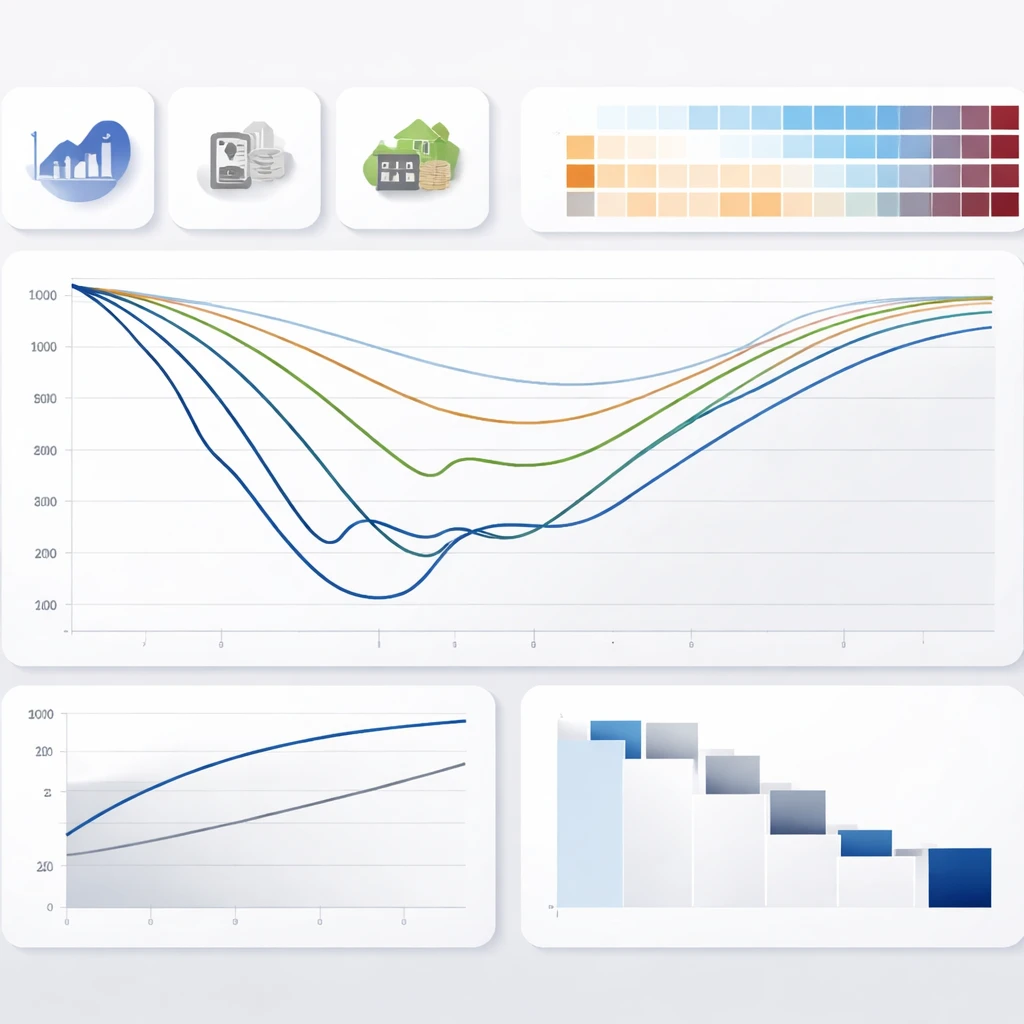
Reporting practices that improve clarity include presenting a small set of headline scenarios, documenting assumptions, providing ranges around key drivers, and showing both loss and liquidity impacts. Visual summaries such as heat maps and waterfall charts can highlight which factors dominate risk, provided that the underlying calculations are transparent.
Ongoing Maintenance and Calibration
Risk landscapes change. New instruments are added, exposures drift with market moves, and macro regimes evolve. Stress testing frameworks benefit from periodic calibration. Historical windows used to size shocks can be updated. Factor mappings can be refined when new data suggests different sensitivities. If the portfolio introduces new complexities, such as additional derivatives or private structures, the stress library and liquidity assumptions should expand accordingly.
Documentation is part of maintenance. Maintaining a record of scenarios, assumptions, and outcomes allows reviewers to understand changes over time and reduces the risk of ad hoc adjustments that obscure trends in resilience.
What Stress Tests Do Not Provide
Stress tests do not predict the next crisis, nor do they specify definitive actions. They do not replace full asset-liability models, and they should not be interpreted as point estimates of future losses. Their value lies in providing a structured way to examine adverse states, to identify vulnerabilities, and to improve preparedness across return, risk, and liquidity dimensions.
Key Takeaways
- Stress testing evaluates portfolio behavior under adverse but plausible conditions and complements standard risk metrics by focusing on tails and nonlinear effects.
- Effective portfolio-level tests map holdings to risk factors, incorporate changing correlations, and translate scenarios into price, liquidity, and funding outcomes.
- Historical, hypothetical, reverse, and liquidity-focused stresses each reveal different vulnerabilities, so a diversified scenario set is useful.
- Results gain practical meaning when expressed in planning metrics, such as drawdown tolerance, liquidity coverage, and liability impact, rather than only in returns.
- Models carry limitations, so assumptions should be documented, sensitivities explored, and conclusions treated as decision support rather than forecasts.