
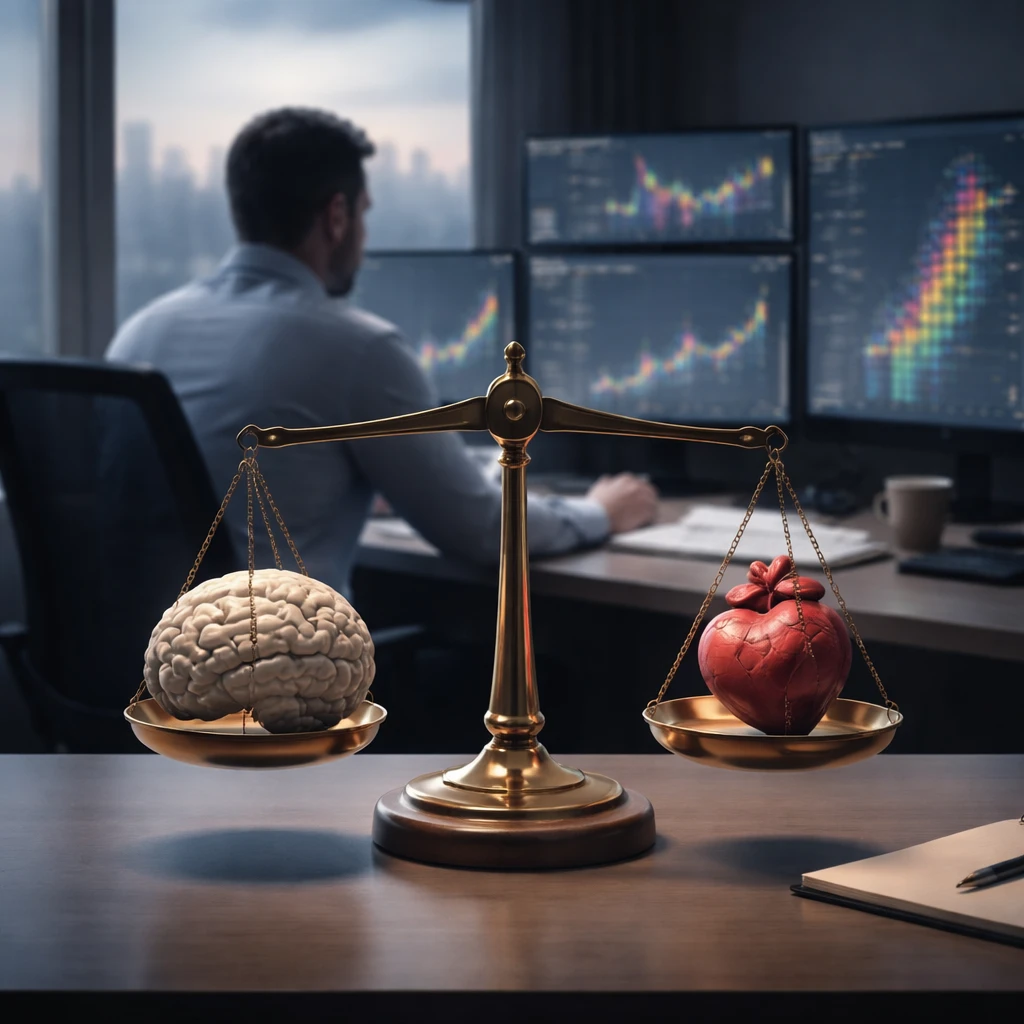
Emotions are not a side note to market participation. They are part of the operating system through which information is filtered, risks are perceived, and actions are initiated or withheld. In trading and investing, outcomes depend not only on analytical skill but also on the ability to maintain consistency when conditions are uncertain and feedback is noisy. Emotional discipline is therefore a foundational element of market competence.
What Emotional Discipline Means in Markets
Emotional discipline refers to the capacity to notice affective states without allowing them to dictate impulsive or inconsistent behavior. It supports adherence to predefined processes in the presence of uncertainty, gains, losses, time pressure, and social influence. This does not require the absence of emotion. It requires the accurate interpretation of emotional signals and the alignment of actions with a deliberate process rather than momentary urges.
Why Emotions Evolved for Survival, Not Markets
Human emotional systems evolved to manage immediate threats and opportunities in environments where feedback was fast and consequences were physical. Markets present abstract risks, delayed feedback, and probabilistic outcomes. A rapid heart rate may be useful when a predator is nearby. It is less useful when a price print fluctuates by fractions of a percent. The mismatch between ancestral triggers and financial stimuli can produce overreactions, underreactions, or pattern detection where no stable signal exists.
How Emotions Shape Perception, Attention, and Memory
Emotions modulate what information is noticed and how it is interpreted. A fearful state tightens attention around perceived threats, sometimes at the expense of base rates or broader context. A euphoric state expands attention but can blunt risk detection. Emotion also biases memory retrieval. After a painful loss, the mind retrieves examples of prior losses more readily, which can amplify caution even when conditions differ. After a run of gains, successful episodes are more accessible, which can inflate confidence.
Decision-Making Under Uncertainty
Market decisions rarely present clear probabilities, and even when probabilities are known, outcomes are noisy. A correct decision can lead to a loss. An unsound decision can lead to a gain. This instability encourages emotional attribution errors. It is easy to credit a win to skill and to blame a loss on bad luck, or vice versa, depending on mood. Emotional discipline improves calibration by separating process quality from outcome variance. Over many trials, disciplined process control improves consistency in risk exposure, error detection, and learning from feedback.
Core Trading Emotions and Their Effects
Emotions come in blends, but certain patterns show up frequently in market contexts. Understanding their typical signatures clarifies why they matter.
Fear
Fear is a fast, protective response to perceived threat. In markets it can be triggered by volatility spikes, unexpected news, or a string of losses. Fear narrows attention and favors immediate risk reduction. It can be useful when it highlights genuine hazard. It can be harmful when it prompts premature exit, refusal to enter a valid opportunity, or abrupt deviation from risk limits due to panic.
Greed
Greed is the pull toward potential gain. It widens attention toward opportunities and encourages persistence. In excess, it drives position size creep, neglect of tail risks, and a shift from process discipline to outcome chasing. It reduces sensitivity to base rates and increases susceptibility to overconfident forecasts.
Hope
Hope sustains effort through drawdowns and uncertainty. It can also delay corrective action. In trading, hope often attaches to losing positions through the belief that mean reversion will arrive before risk limits are breached. Hope is not a plan. When it substitutes for analysis, it becomes a mechanism for holding risk longer than intended.
Regret
Regret is backward-looking and compares actual outcomes to counterfactuals. It can encourage learning when it prompts a sober review of process. It becomes destructive when it triggers revenge behavior, such as attempting to recover losses immediately by increasing risk or abandoning risk controls. Regret also fuels avoidance, such as refusing to reengage with an asset after a mistake despite new information.
FOMO
Fear of missing out emerges when price moves without current participation. It intensifies social comparison and compresses decision time. FOMO tends to shorten horizon, reduce diligence, and move attention from risk profile to entry urgency. This can lead to trades undertaken for emotional relief rather than for expected value based on a method.
Overconfidence
Overconfidence inflates perceived skill relative to variance. After a winning streak, it shows up as larger risk per decision, relaxed criteria, and a tendency to extrapolate recent performance. Overconfidence is not only a trait; it is state dependent, rising and falling with recent outcomes. Recognizing this dynamic is important for keeping risk exposure aligned with a stable process rather than with temporary feelings of invulnerability.
Feedback Loops Between Emotion and Outcome
Emotion and outcome create loops that can magnify both strengths and weaknesses. A disciplined action that is rewarded may strengthen future discipline, while an undisciplined action that is rewarded may reinforce poor habits. Similarly, a disciplined action that is punished by short-term variance can weaken confidence even if the decision quality was sound. Effective practitioners differentiate between outcomes that convey meaningful information about process quality and outcomes that reflect noise. This distinction moderates emotional swings and supports stable behavior across cycles.
Loss Aversion, Reference Points, and Utility
Behavioral research finds that losses loom larger than gains of equal size. Traders often evaluate outcomes relative to a reference point, such as an entry price or a high watermark. When price dips below the reference, the utility function steepens, and emotions intensify. This can lead to asymmetric responses, such as cutting gains quickly to secure a win but holding losses to avoid realizing pain. Recognizing the role of reference points helps explain why consistent decision rules often outperform moment-to-moment judgment in emotionally charged states.
Stress Physiology and Cognitive Bandwidth
High arousal changes physiology. Heart rate rises, breathing shortens, and cortisol and adrenaline increase. These changes prepare the body for action but can degrade executive functions that matter for trading, including working memory, impulse control, and probabilistic reasoning. Even mild sleep deprivation amplifies these effects. Over time, poorly managed arousal can produce a chronic stress baseline that shifts one toward reactive behavior. Awareness of arousal is not about seeking calm at all costs. It is about matching arousal to task demands and recognizing when physiology is compromising the quality of judgment.
Social Influence and Narrative Contagion
Markets aggregate beliefs. Social media, news flows, and peer conversations create narratives that rise and fall in strength. Emotional tone spreads through groups. Excitement and fear both propagate quickly, especially when volatility increases. Social confirmation can be informative when it highlights new facts. It can also bias attention toward consensus and discourage independent evaluation. The emotional pull of belonging can nudge decisions away from process and toward alignment with group mood.
Time Horizon and Long-Term Performance
Emotional impulses are typically short term. They emphasize immediate relief from discomfort or the quick capture of pleasure. Long-term performance depends on repeated adherence to a coherent process across many decisions. The central challenge is temporal: balancing short-term affective pressures with long-term statistical objectives. In this context, emotional discipline supports consistency. Consistency allows learning through stable feedback, more accurate evaluation of methods, and lower variance in risk exposure. Over multi-year horizons, these compounding benefits can exceed the marginal gains from occasional inspired improvisations that lack repeatability.
Process Control and Emotional Awareness
Emotional awareness is most useful when integrated into process control. Many experienced practitioners treat emotions as data, similar to volatility or liquidity measures. They monitor arousal, note repetitive triggers, and adjust the decision environment accordingly. The goal is not emotional suppression. It is to maintain alignment between actions and a clearly defined approach to risk, regardless of temporary feelings.
Practical Mindset-Oriented Examples
Example 1: The Temptation to Average Down
Consider a position that moves against the initial thesis. The trader notices discomfort and the impulse to add size to reduce the average entry price. The emotion here is a blend of hope and loss aversion. By adding, the unrealized loss may appear smaller on a per-unit basis, which temporarily eases discomfort. If the thesis is wrong, cumulative exposure rises precisely when the probability of error may be increasing. Emotional discipline in this scenario involves recognizing that relief is driving the urge. The psychologically satisfying action differs from the action supported by an evidence-based process.
Example 2: Overconfidence After a Hot Streak
After several successful trades, a trader feels fluent and in sync with the market. Screening criteria loosen without conscious intent. Positions become larger relative to account size. A small adverse move now generates outsized emotional reactions because the exposure is bigger. If a loss arrives, the swing from confidence to doubt can be steep. The practical lesson is not a rule about sizing, but a recognition that state-dependent overconfidence can quietly alter risk and attention. Detecting that state early protects process consistency.
Example 3: Price Anchoring
Anchoring to an entry price or a previous high changes how new information is processed. Suppose fresh data conflicts with the original thesis while price hovers near the anchor. Discomfort rises because updating the view would imply realizing a mistake. Hope and identity become entangled with the position. The trader focuses on confirming data and discards disconfirming evidence. Over time, the information asymmetry grows, yet the position remains. Here, emotion shapes attention, not just action, and the cost is opportunity and learning.
Example 4: FOMO During Abrupt Rallies
In a fast move upward, feeds fill with charts and celebratory commentary. The felt pressure is not purely about expected value. It is social and time based. The trader experiences the discomfort of exclusion and the belief that the window is closing. Decisions made under FOMO tend to compress due diligence and elevate entry urgency. The impact on long-term performance is increased variance because trades initiated for emotional relief are less tied to process edge.
Example 5: Revenge Behavior After a Sharp Loss
A quick loss can trigger anger that aims at restoring a sense of control. The next decision is taken rapidly, with larger size, minimal analysis, and the implicit goal of recovering. Even when this decision wins, the habit it reinforces can damage performance through greater tail risk. The emotional target is relief from shame or frustration rather than alignment with a method.
Separating Process Quality from Outcome Noise
Emotions tend to follow outcomes, but outcomes are noisy. The challenge is to evaluate whether a result reflects process strength or randomness. This evaluation requires records and clear criteria. Without them, emotions fill the void. A calm but incorrect decision can feel fine, and a correct but temporarily losing decision can feel awful. Over hundreds of trades, error rates in judgment often decline when the evaluation framework is explicit and consistent, because emotions have less room to redefine success after the fact.
Designing the Decision Environment
Environment influences emotion. Time pressure, notification volume, and visual clutter elevate arousal and bias attention. Many professionals shape their decision environment to reduce unnecessary triggers. Common adjustments include limiting information sources to those that bear directly on a method, creating buffers between analysis and action, and scheduling reviews outside of market hours to separate reflection from live arousal. The principle is simple. When the environment is predictable and structured, emotions have fewer opportunities to hijack attention.
Measurement, Reflection, and Learning
Learning requires feedback that distinguishes choices made in discipline from choices made in reaction to emotion. Some practitioners track process metrics such as the percentage of decisions taken under explicit criteria, the frequency of unplanned deviations, time-to-decision under stress, and adherence to predefined risk limits. Reflection sessions then review a small number of decisions in depth, focusing on emotions present, which cues were noticed or ignored, and how these factors aligned with process. Over time, such measurement supports more accurate self-assessment. Emotional episodes become data points rather than mysteries.
Misconceptions About Emotion in Trading
Several misconceptions complicate the relationship between emotions and performance.
- Good traders feel nothing. In reality, experienced participants report emotions, but they respond differently to them. They notice, label, and choose actions aligned with process.
- Emotions are only harmful. Some emotional signals convey useful information about risk, conviction, or fatigue. The harm arises when feelings replace analysis.
- Discipline means rigidity. Discipline is consistent adherence to principles, not refusal to update. It includes structured flexibility based on new evidence.
- Confidence eliminates fear. Confidence coexists with uncertainty. It reflects trust in process rather than certainty in outcome.
Ethical and Practical Boundaries
Emotional discipline is a performance factor, but it also intersects with well-being. Sustained stress can affect health. Some individuals benefit from professional support in managing anxiety, sleep, or decision pressure. In market contexts, ethics also matter. Emotional states can tempt individuals to rationalize actions that conflict with rules or integrity. Protecting integrity is a component of discipline. Long-term performance is not purely financial. It includes maintaining a decision process that is both effective and ethically sound.
How Emotions Shape Long-Horizon Outcomes
The cumulative impact of emotions on performance emerges through repeated small decisions. A few impulsive deviations might not register in quarterly results, but they can compound through increased variance, skewed risk exposure, and diminished learning. Conversely, many small acts of restraint protect capital and preserve cognitive bandwidth for higher quality decisions. Over years, this divergence can produce markedly different equity curves even when analytical skill is similar. Emotional discipline functions like friction control in an engine. It does not add horsepower, but it prevents waste and overheating, allowing the system to perform closer to its design potential.
Cultivating Self-Awareness in Practice
Self-awareness is supported by specific habits observed among experienced practitioners. These are not prescriptions but examples of how awareness can be embedded in routine.
- Emotion labeling. Briefly naming the emotion during decisions clarifies what is happening internally. Labels such as fear, excitement, or frustration help separate feeling from fact.
- Pre-mortem analysis. Before a decision, imagining plausible ways it could fail reduces surprise and moderates subsequent affect if adverse outcomes occur.
- Checklists. Structured criteria reduce reliance on fluctuating states by externalizing key steps.
- Journaling. Writing about a decision shortly after taking it captures the emotional context before hindsight edits the memory.
- Recovery routines. After intense sessions, routines that downshift arousal support clearer thinking in the next session.
These practices work by converting emotions from invisible drivers into observable variables. Once observable, they can be managed within a process rather than fought internally.
Uncertainty, Agency, and Acceptance
Markets do not guarantee that good process will produce short-term gains. Accepting this reduces the need for emotional relief trades. Agency comes from controlling what is controllable, such as the clarity of a method, risk definitions, and personal readiness. Acceptance of uncertainty is not resignation. It is a recognition that discipline operates at the level of actions, not outcomes. With that frame, emotions become inputs to be acknowledged and integrated, not obstacles to be eliminated.
Key Takeaways
- Emotions shape perception, attention, and memory in markets, which directly influences decision quality under uncertainty.
- Emotional discipline is not suppression but alignment of actions with a defined process despite fluctuating feelings.
- Common states such as fear, greed, hope, regret, and overconfidence are predictable and can be recognized through their behavioral signatures.
- Long-term performance depends on consistency across many decisions, which emotional discipline supports by stabilizing risk exposure and learning.
- Making emotions observable through habits like labeling, structured reviews, and environmental design turns them into data rather than hidden drivers.