
Introduction
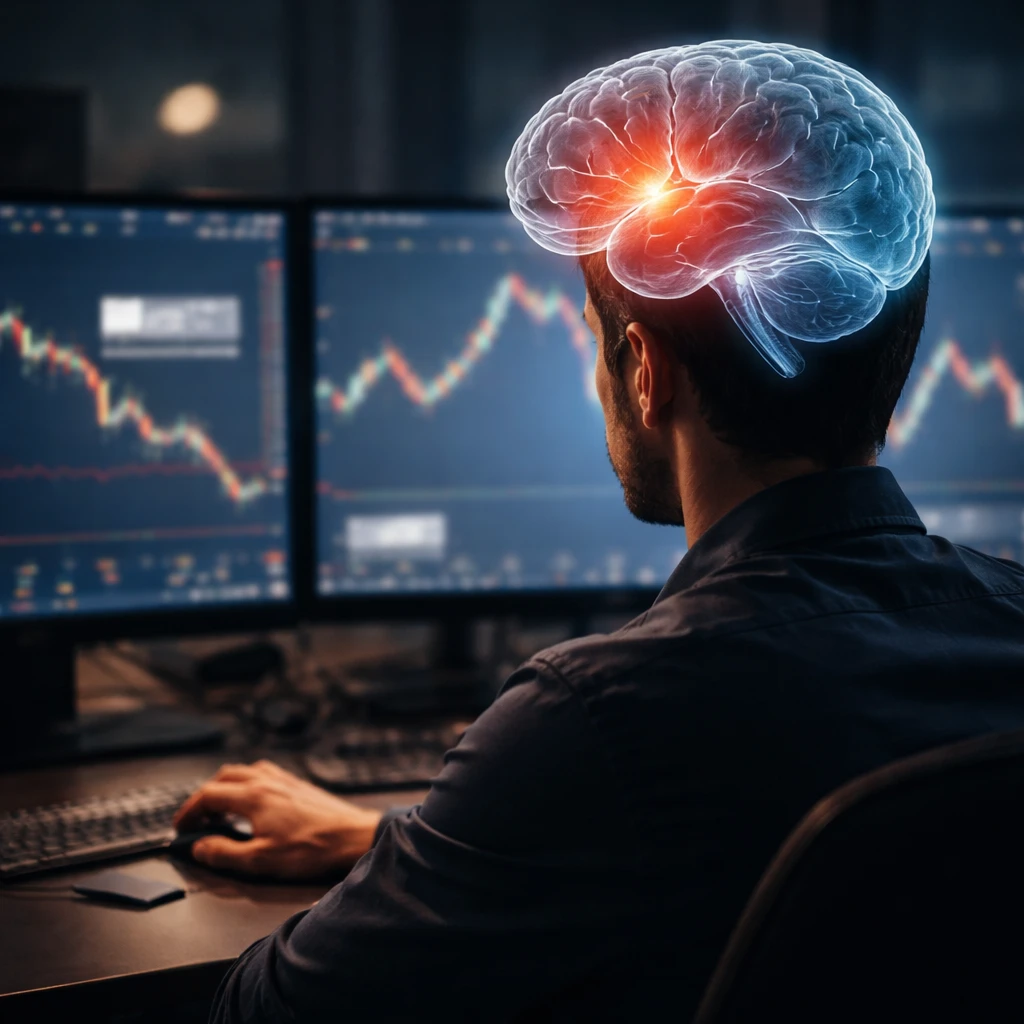
Impulse trading describes a class of decisions taken rapidly and with limited deliberation, typically in response to emotionally charged cues such as fear of missing out, frustration after a loss, or sudden market headlines. The behavior is not defined by speed alone. It is defined by a shift away from planned, criteria-based judgment toward affect-driven choices that bypass one’s normal decision process. Understanding this shift matters because impulsive actions tend to degrade discipline, introduce inconsistency, and increase variance in results over time.
This article explains the psychology of impulse trading, why it emerges under uncertainty, how it affects decision quality and long-run performance, and how to recognize and counter the conditions in which it arises. The focus is on mindset and process, not on strategies or signals.
What Is Impulse Trading
Impulse trading is any trade decision made with minimal reflection that departs from one’s predefined process in order to chase relief, excitement, or closure. The behavior often manifests as a reaction to salient stimuli, for example a sharp price move, a social media post that signals urgency, or the sensation of needing to “get back” after a loss. The core feature is a contraction of deliberation. Criteria that would normally be consulted are skipped or truncated, and the expected value of the action is not evaluated with the same rigor that would be applied in a calm state.
It is important to separate legitimate fast decisions from impulsive ones. Many market choices are made quickly yet remain deliberate and rule-consistent. The distinction is psychological rather than temporal. A fast decision can be the output of a practiced plan. An impulsive decision is a bypass of the plan.
Why the Concept Matters
Impulse trading matters for three interconnected reasons. First, it degrades consistency. A discipline that changes with mood or headlines cannot be measured or improved reliably. Second, it inflates the dispersion of outcomes. Even if the average result of a process is acceptable, impulsive deviations increase tail risk by introducing actions that were not stress-tested. Third, it crowds out attention and capital that could be applied to higher quality decisions. Each impulsive action has an opportunity cost, including the cognitive resources required to manage and monitor it.
Viewed over many decisions, even a small frequency of impulses can impose a significant drag on performance. This drag appears through higher transaction costs, unfavorable selection of volatility regimes, and time spent unwinding low-conviction positions that would not exist under a stable process.
Psychological Mechanics of an Impulse
Impulse trading arises when fast, affective processing dominates reflective evaluation. A useful framework distinguishes two interacting modes of cognition. One mode is quick, automatic, and driven by emotion and pattern recognition. The other is slower, deliberate, and rules oriented. Both are necessary. Under pressure, however, the automatic mode can overwhelm the deliberate mode, particularly when the environment is noisy and feedback is immediate.
Several mechanisms amplify this shift:
Affect and Salience
The affect heuristic steers judgment using current mood and bodily signals. A vivid price move or a flashing notification creates salience that is processed as urgency. Emotional arousal compresses time horizons and narrows the field of view. Information that fits the current affective state looks more credible, while conflicting data is discounted.
Stress Physiology
Market uncertainty can elevate stress hormones, which sharpen sensitivity to threat and opportunity while impairing working memory. Under heightened arousal, the brain allocates attention to immediate cues. The result is attentional tunneling. Complex criteria that require reflection are quietly dropped in favor of simple approach or avoid responses. This shift is adaptive in acute danger, but it is misaligned with tasks that benefit from careful balance of probabilities.
Loss Aversion and the Urge to Repair
Losses weigh more heavily on subjective value than gains of equal size. After a realized or perceived loss, the desire to repair the account balance can trigger urgent action. The behavior known as revenge trading is an expression of this urge. The individual seeks to neutralize the discomfort of loss quickly, not to maximize expected value.
Recency and Pattern Imagination
Recent outcomes are overweighted relative to their true information content. A price move that just occurred feels more predictive than it is. Combined with the human tendency to find patterns in noise, this recency effect can make weak signals appear strong enough to act on immediately.
Overconfidence and Control Illusions
Success in an unrelated context or a good run of results can produce unwarranted confidence. People often overestimate their ability to time entries and exits, particularly in volatile conditions. This overconfidence interacts with platform design features such as instant execution and encourages decisions that are faster and less scrutinized than usual.
Impulse Trading Under Uncertainty
All trading involves uncertainty, incomplete information, and delayed feedback. These conditions make it hard to evaluate whether a particular decision was good or bad. Under such ambiguity, judgment relies on mental models and base rates. Impulse trading disrupts that reliance. Instead of anchoring decisions to prior data and clearly defined criteria, the mind substitutes immediate feelings and salient observations. The substitution is convenient but fragile. It performs poorly when noise is high and when the environment contains many false patterns.
Uncertainty also amplifies the power of social cues. In ambiguous situations, people look to others for guidance. Real-time chats, headlines, and social feeds supply a stream of confident voices. The presence of consensus, or the appearance of it, can be misread as evidence. An individual who would pause in isolation may act quickly in a crowd, even though the factual basis for action has not improved.
Speed, Accuracy, and the Cost of Delay
Decision research describes a trade-off between speed and accuracy. When the perceived cost of delay rises, the mind accepts a higher error rate. Markets often present information in ways that inflate the cost of delay. For example, a moving price or a limited-time notice creates urgency. The perception that waiting will be punished pushes choices into the impulsive zone. The key point is not that speed is harmful. It is that unexamined increases in perceived urgency shift the operating point toward more errors.
Micro-Decisions and Cumulative Drift
An impulsive trade rarely stands alone. It is followed by micro-decisions about stops, profit taking, and whether to add or exit. Each subsequent choice inherits the affective state that created the first action. This chain can drift far from the original plan. Even without extreme outcomes, the cumulative effect is a portfolio of decisions that would not pass the same criteria in a neutral state.
Recognizing Triggers and Early Warning Signs
Impulse control begins with detection. Triggers can be external, internal, or environmental. External triggers include dramatic price moves, breaking news, or a peer’s confident statement. Internal triggers include boredom, frustration, fatigue, and the desire to relieve uncertainty quickly. Environmental triggers include design elements that reduce friction, such as one-click execution or frequent push notifications.
Early warning signs are often somatic and linguistic. Somatic signs include elevated heart rate, shallow breathing, an urge to click quickly, or restlessness. Linguistic signs include thoughts that start with must, now, only this time, or I just need to. These cues signal a shift toward short-horizon thinking. When these signs appear, the probability of an impulse increases, even if the individual feels confident in the moment.
Practical Mindset-Oriented Examples
Example 1: The Breakout Headline
A trader reads a headline suggesting a major product launch. The price spikes. Without checking the source, the trader clicks buy to avoid missing the move. The decision is driven by affect and salience. The mind frames the situation as a once-only window. Later, the headline is revised and the price reverts. The lesson is not that headline trades are always wrong. It is that the urge to act immediately bypassed quality checks that would normally apply to market-moving news.
Example 2: Revenge After a Loss
After a stop-out, the trader feels a strong urge to reenter immediately. The action is experienced as restoring fairness or proving that the idea was right. The second trade is larger than usual and has weaker justification. The driver is the need to repair loss-induced discomfort rather than a measured assessment of the opportunity.
Example 3: Boredom and the Search for Stimulation
During a quiet session, the trader feels under-engaged. Scanning for activity becomes a substitute for analysis. A small uptick in price is enough to trigger a long entry, which provides stimulation and a sense of doing something. The trade exists to resolve boredom, not because it meets pre-established criteria. Even if it profits, the reinforcement strengthens the boredom-impulse link and makes future impulsive behavior more likely.
Example 4: Social Proof in a Fast Room
In a chatroom, several participants post that a symbol is going higher. Screenshots of quick gains circulate. The trader joins in without independent evaluation, interpreting group enthusiasm as validation. In truth, the probability or payoff of the trade did not improve. What changed was the perceived safety of acting in a crowd.
Example 5: Anchoring and the Price That Got Away
The trader watched a security at 48 but did not act. It jumps to 50. The mind anchors to 48 and forms the belief that 50 is already late. To avoid the discomfort of missing out, the trader chases at 50.50, then exits quickly if it dips, repeating the chase. The sequence is driven by the need to relieve regret rather than by a principled evaluation of value and risk.
Building Emotional Discipline Without Strategy Prescriptions
Emotional discipline is the capacity to maintain process fidelity under variable affective states. It does not require stoicism or the absence of emotion. It requires structures that keep reflective judgment involved when emotions run high. The following practices are presented as general psychological tools. They are not strategy recommendations and do not specify what to trade or when.
Friction and Delay as Tools
Impulse thrives on speed and low friction. Small, intentional frictions reduce the rate of impulsive actions by creating a natural pause. Examples include short cooling-off intervals before execution, confirmations that require a brief note describing the reason for the trade, or a simple checklist that must be acknowledged. The purpose is not to block action, but to allow reflective systems enough time to participate.
Language and Cognitive Reappraisal
Putting feelings into words reduces their grip on behavior. Brief labeling such as feeling urgent or feeling frustrated can lower arousal and restore perspective. Reappraisal shifts the frame from immediate relief to process quality. A common reappraisal is to view missed trades as neutral data rather than as mistakes that must be corrected. This reframing reduces the compulsion to chase.
Pre-Commitment and Identity
Impulses are sensitive to identity cues. If a person views themselves as a disciplined decision-maker, actions that conflict with that identity feel costly. Pre-commitment tools leverage this by setting clear personal standards for process adherence. The point is not to bind oneself to rigid rules forever, but to protect reflective judgment at the moments when it is most vulnerable.
Healthy Use of Data About Oneself
Self-observation can be structured without prescribing trades. A simple log that records time of day, emotional state, level of urgency, and whether a trade deviated from process can reveal patterns. Many people find that impulses cluster around specific times, such as immediately after a loss or late in a session. Once visible, these patterns are easier to disrupt.
Environmental Design
The digital environment can be adjusted to reduce incidental triggers. Limiting nonessential notifications, arranging screens to present information in a calmer layout, or separating analysis from execution windows can meaningfully reduce the frequency of urgent clicks. The design goal is a workspace that invites deliberation.
Recovery Rituals
Even with preparation, impulses occur. A useful mindset is to treat them as signals for learning rather than occasions for harsh self-critique. A short debrief that reconstructs antecedents, feelings, and context preserves the information needed for improvement. Over time, the debrief record helps distinguish between beneficial flexibility and harmful impulse.
Consequences for Long-Term Performance
Impulse trading affects long-run performance through several pathways. First, it introduces trades with lower expected value because they bypass the filters that normally screen out weak ideas. Second, it increases variance by clustering activity in volatile moments when slippage and spread costs are higher. Third, it increases cognitive load, since impulsive positions tend to demand more monitoring, which diverts attention from planned analysis.
There is also a volatility tax on performance. Decisions that increase variance without increasing average return reduce geometric growth. Even modest increases in error rate can compound into noticeable underperformance over many cycles. This effect is often invisible in the short run but becomes clear when reviewing a long series of results.
Psychological capital is also consumed. Repeated impulsive actions and their aftermath erode confidence in one’s process, which can lead to oscillation between overcontrol and overtrading. The individual swings from rigid avoidance to urgent action, neither of which reflects sound judgment. Restoring a stable middle requires renewed attention to process and environment.
Distinguishing Flexibility From Impulse
Flexibility is the capacity to adapt to new information without abandoning standards. Impulse is adaptation without standards. The difference shows up in preparation and documentation. Flexible decisions can be explained with reference to criteria that existed before the moment of action, even if those criteria allow for discretion. Impulsive decisions are hard to justify once the emotional charge fades.
In practice, constructive flexibility appears as measured adjustments in position size, timing within a pre-considered window, or selective abstention when the market does not fit one’s framework. None of these require speed for its own sake. They require clarity about what constitutes a valid reason to change course.
Social and Cultural Influences
Trading culture can either normalize impulse or encourage discipline. Environments that glorify constant action, publicize isolated wins, or celebrate speed as a virtue increase impulsivity. By contrast, environments that prize process quality, careful post-trade review, and transparent discussion of error create social reinforcement for deliberation. Since humans are social learners, the norms one absorbs will shape behavior even when working alone.
A Framework for Daily Practice
A workable framework for emotional discipline integrates three elements: awareness, structure, and reflection. Awareness means noticing affective shifts and environmental triggers. Structure means having predefined process elements that keep reflective judgment involved, such as brief delays, checklists, and documentation prompts that do not prescribe what to trade. Reflection means periodic review that focuses on decision quality rather than on outcomes alone. The framework does not eliminate emotion. It channels it into a supportive role.
Applying the Concepts to Personal Context
Individual differences matter. Some people are more reactive to losses, others to boredom or social cues. Personality traits such as sensation seeking or need for closure influence which triggers are most potent. The goal is not to copy someone else’s routine, but to understand one’s own risk profile for impulsive decisions and select tools that fit. What works is usually simple, repeatable, and minimally intrusive. Sophisticated interventions are unnecessary if small, consistent practices are in place.
Limits of Willpower
Relying on willpower alone is unreliable. Decision fatigue accumulates over the day. As cognitive resources decline, the rate of impulses tends to rise. Systems that reduce the need for constant restraint are more durable. For example, placing documentation prompts between analysis and execution reduces reliance on moment-to-moment self-control. The emphasis shifts from resisting temptation to designing the context so that temptation is less frequent and less urgent.
When Impulses Signal Something Useful
Not every urge to act quickly is irrational. Sometimes a strong impulse is a signal that something important has changed. The distinction lies in corroboration. If the impulse remains compelling after a brief pause and after contact with basic checks, it may reflect tacit pattern recognition built from experience. The risk is to treat all urgent feelings as insight. Healthy skepticism preserves the benefits of intuition without letting it dictate action unilaterally.
Repairing After an Impulsive Action
When an impulse has occurred, the immediate challenge is to prevent a cascade. A short cool-down, followed by a factual reconstruction of the decision, helps separate signal from noise. Recording the antecedents, internal state, and context can make the episode useful for future prevention. Over time, these records often reveal that impulses cluster around particular emotions or times. Recognizing the clustering allows one to anticipate vulnerable moments and engage protections proactively.
Conclusion
Impulse trading is a predictable human response to a stimulating, uncertain, and socially rich environment. It occurs when immediate feelings take precedence over structured evaluation. The costs are real, yet avoidable in part. By understanding the psychological mechanics, recognizing personal triggers, and designing modest frictions and reflective practices, individuals can preserve the advantages of speed and intuition without sacrificing discipline. The objective is not perfect control. It is reliable decision quality across a range of emotional states.
Key Takeaways
- Impulse trading is defined by a bypass of one’s normal process, not by speed alone, and is driven by affect, salience, and stress.
- Under uncertainty, impulses substitute feelings and social cues for base rates and criteria, which degrades decision quality.
- Small frictions, emotion labeling, and pre-commitment structures keep reflective judgment involved without prescribing strategies.
- Impulses cluster around specific triggers such as losses, boredom, and social proof, and can be detected through early somatic and linguistic signs.
- Over many decisions, impulsive actions increase variance, transaction costs, and cognitive load, eroding long-term performance.