
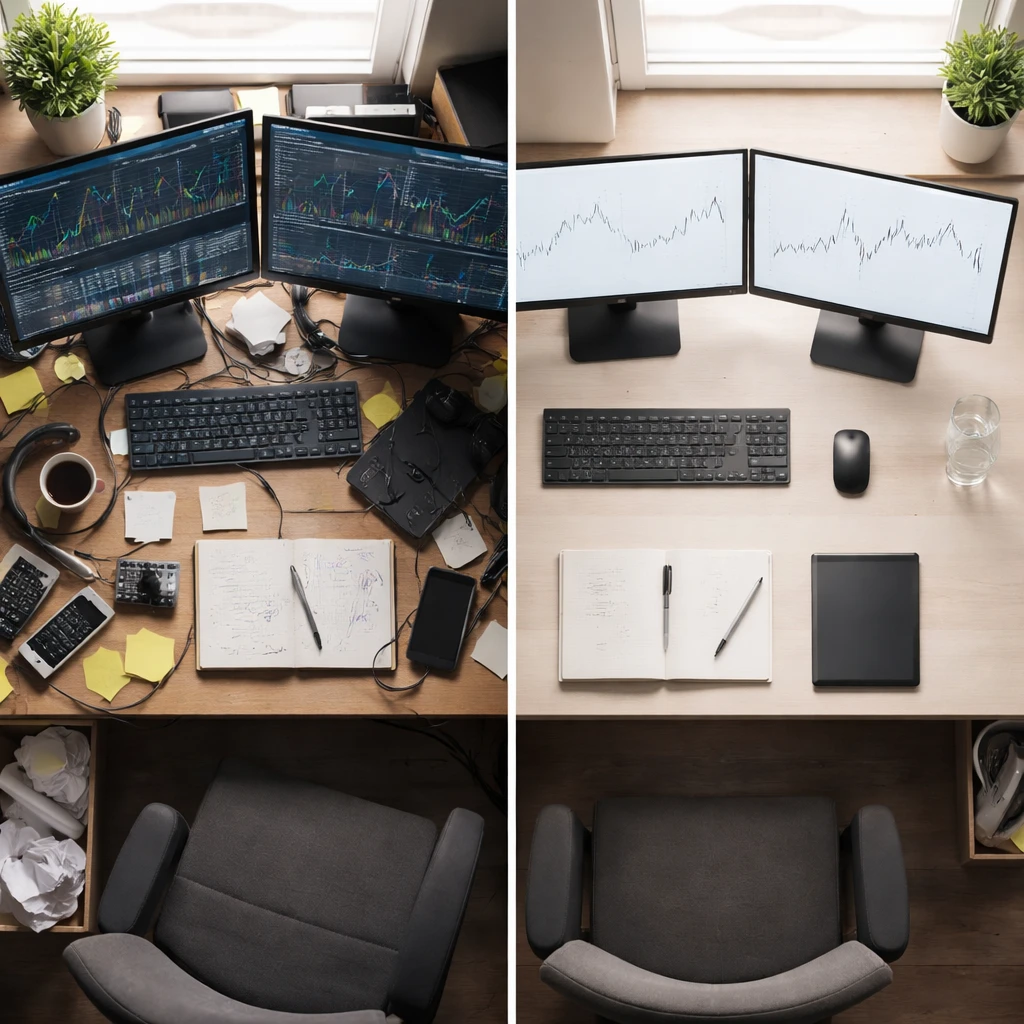
Decision-making in markets rarely hinges on a single choice. It is a steady stream of small judgments that accumulate across a session and across a career. Every information check, every confirmation, every moment of hesitation, and each switch of attention carries a cognitive cost. Over time, those costs compound into fatigue that reduces the quality of later decisions. Reducing decision fatigue is therefore not a tactic to extract an edge from the market. It is a mindset and habit system designed to protect attention and preserve discipline when uncertainty is high and choices are numerous.
What Is Decision Fatigue
Decision fatigue refers to the decline in decision quality after sustained decision-making. As mental resources are consumed by continual choices, people tend to rely more on shortcuts, become more risk averse or more risk seeking in inconsistent ways, default to the status quo, or act impulsively. In applied settings such as clinical judgments or legal rulings, researchers have documented time-of-day and sequence effects that correlate with decision load and rest intervals. The exact mechanisms remain debated, but the practical observation is stable. When cognitive demands pile up, later decisions become noisier and less disciplined.
Several cognitive processes converge to produce this effect. Working memory becomes cluttered, attention narrows, and the ability to inhibit prepotent responses weakens. The brain increasingly defaults to pattern completion and heuristic shortcuts. Under uncertainty, where there is no guaranteed correct answer, this shift can be costly. Traders and investors operate in precisely this environment, with incomplete information, probabilistic outcomes, and time pressure.
Why Decision Fatigue Matters in Markets
Markets force many micro-decisions that do not look significant in isolation. Which data to consult first. Whether to open a new screen or continue analysis. How long to wait before refreshing a chart. Whether a headline merits attention. Whether to recheck a prior conclusion after a price move. Each choice draws on limited attention and self-regulatory capacity. As those resources wane, two patterns become common. One is impulsive action driven by immediate cues. The other is avoidance, such as postponing a needed judgment, or sticking with a comfortable default without adequate review. Both patterns can undermine a carefully designed process.
The cumulative effect is not limited to intraday activity. Decision fatigue also influences end-of-day records, reflection, and planning. When depleted, people tend to compress notes, skip review steps, or rationalize exceptions rather than examine them. Over weeks and months, the result is weaker feedback, slower learning, and a more fragile process.
Decision-Making Under Uncertainty
Uncertainty amplifies decision fatigue because there is no single correct path that can be applied automatically. People must weigh conflicting evidence, tolerate ambiguity, and update beliefs as new data arrive. This forces System 2 processing, the slower and more effortful mode that evaluates arguments and counterarguments. With repetition, effortful processing becomes taxing, and the mind shifts toward faster heuristics. Heuristics are not inherently bad. They are essential for functioning in complex environments. The difficulty is that fatigue degrades judgment about when a heuristic is appropriate and when it is not.
Common fatigue-related shifts include narrowing attention to a single cue while ignoring base rates, overweighting vivid or recent information, and misreading randomness as structure. Fatigue also increases susceptibility to framing effects, such as treating equivalent outcomes differently depending on how information is presented. Under uncertainty, these shifts can create inconsistent choices across similar situations, which is the hallmark of degraded discipline.
Recognizing Decision Fatigue in Practice
Awareness is the first line of defense. Typical markers include escalating screen or tab switching, rereading the same data without new insight, increasing reliance on headlines or social cues, difficulty articulating the reason for a decision, and a growing tendency to break one’s own procedural rules. Physiological signs also matter, including shallow breathing, hunched posture, and a feeling of urgency out of proportion to the situation.
Not all low-energy states are the same. Boredom, overstimulation, and anxiety can look similar to fatigue but call for different responses. Fatigue often follows a pattern across a session. Early choices feel deliberate, mid-session choices feel rushed, and late-session choices rely on habit or avoidance. Monitoring these patterns helps separate transient emotion from cognitive depletion.
Habit Formation as a Protective Mechanism
Habits conserve mental energy by shifting routine choices from effortful processing to automatic execution. The key is to design habits that handle low-variance tasks, leaving limited attention for high-variance judgments. A well-constructed routine removes hundreds of micro-decisions that would otherwise erode discipline.
Effective habits share three characteristics. First, they are tied to a clear cue, such as a time of day or a specific environmental trigger. Second, they specify a short sequence of actions with minimal branching. Third, they end with a small reward or closure step that signals completion. Over time, repetition strengthens the cue-response link, which reduces the cognitive cost of initiating the routine.
Structuring Choice Architecture
Choice architecture refers to the way options are presented and how defaults are set. In markets, choice architecture includes the layout of screens, the order in which information is reviewed, and the friction in taking certain actions. Thoughtful design reduces unnecessary choices and highlights what matters.
Consider an example unrelated to specific trades. Before a session, an investor specifies a short list of information sources considered essential, arranged in a consistent order. During the session, information outside that list is deferred to a time block reserved for scanning. The default is to ignore unplanned inputs until that block. This simple structure removes dozens of micro-choices about when to chase new data and when to stay with the plan.
Practical Mindset-Oriented Examples
The following examples illustrate how to reduce decision fatigue without prescribing strategy or recommending any investment action. The emphasis is on conserving cognitive resources and preserving consistent judgment.
1. Pre-Session Activation and Boundary Setting
Start with a short activation routine tied to a fixed cue, such as the same start time each day. The routine might include a one-minute breathing cycle to stabilize attention, a rapid physical check for posture and tension, and a concise statement of what today’s workload includes. The point is to shift from default mode to task mode with minimal friction. Then set boundaries that protect attention. Decide in advance which categories of information will be considered relevant today and which will be parked. If new, unexpected information arises, route it to a later review block instead of evaluating it immediately.
2. Define a Limited Information Diet
Broad information access can expand insight, but open-ended consumption increases decision load. A limited information diet specifies a small number of inputs that are reviewed consistently, in the same order, at set times. The diet might include market data, macro releases, or sector summaries, but the key is stability and order, not quantity. When the order is stable, each step triggers the next without deliberation, which reduces mental switching costs.
3. Batch Decisions by Type and Time
Batching reduces context switching. Group similar tasks together and allocate fixed windows. For example, place all portfolio-level maintenance checks in a single block rather than sprinkling them throughout the day. Place exploratory reading or research into a separate block. By reducing the number of transitions between modes of thinking, batching lowers the cognitive toll that accumulates with every shift of attention.
4. Use a Simple Pre-Decision Checklist
Checklists do not determine outcomes in uncertain environments, but they prevent avoidable errors. A pre-decision checklist can be short. Is the information complete enough to support a judgment. Have alternative explanations been considered. Is the decision consistent with the process one intends to follow. Can the reasoning be summarized in one or two sentences without resorting to vague language. The act of answering these checks requires little effort once it is habitual, yet it filters impulsive choices.
5. Design Friction for High-Stakes Choices
When fatigued, people act quickly on salient cues. Introduce small, deliberate friction for high-stakes choices. Examples include a 60-second pause before irreversible actions, an additional confirmation step that asks for the reason in plain language, or a brief walk away from the screen to reset attention. Friction is not a barrier to action. It is a safeguard against acting while depleted.
6. Establish Non-Decision Defaults
Defaults reduce decision volume. For routine conditions, set a default course that requires no active choice. Only when predefined conditions are met should a new decision be considered. For instance, if scheduled data are missing or a tool is malfunctioning, the default might be to defer activity until conditions normalize, rather than improvising. Clear defaults prevent ad hoc choices when attention is thin.
7. Control Environmental Stimuli
Attention is sensitive to visual and auditory noise. A cluttered workspace invites incidental choices about where to look and what to handle next. An orderly workspace, consistent screen layout, muted color palette, and minimized notifications remove dozens of small attention grabs. These adjustments are not cosmetic. They directly reduce the number of decisions about priorities that would otherwise arise from environmental distractions.
8. Time-Box News and Social Feeds
Open-ended scanning generates unbounded micro-decisions. Time-boxed windows for news and community input create a clear start and stop, which reduces the temptation to evaluate every new item as it arrives. During focus blocks, close feeds entirely. This prevents the accumulation of trivial choices about whether to open another tab or follow a link.
9. Protect Physical Drivers of Cognitive Stability
Cognition is embodied. Hydration, nutrition, sleep regularity, and short movement breaks support attention and self-control. Studies on depletion have shown mixed findings regarding specific biochemical mechanisms, yet practitioners consistently observe better decision quality when basic physiological needs are stable. Short breaks that involve standing up and changing posture, even for a minute, can reset vigilance and reduce the drift toward impulsive action late in a session.
10. Standardize Non-Market Choices
Decision resources are shared across domains. Reducing nonessential choices outside market hours preserves capacity for complex judgments. Examples include planning meals, clothing, and exercise times in advance and placing recurring tasks on a fixed schedule. These routines lighten cognitive load before the session begins and prevent small logistical choices from bleeding into market work.
11. Close the Loop With Brief Post-Session Notes
Fatigue is often highest at the end of a session, which is exactly when accurate self-observation matters. Use a short, standardized template for notes. State what was done, what was skipped, and what to review later. Keep the format identical day to day, so the act of writing requires little deliberation. The goal is not to produce lengthy narratives. It is to capture consistent observations that feed learning without adding a new decision burden.
Consistency Through Routines and Cues
Consistency is a product of stable cues and clear routines. A routine that starts with a cue, proceeds through a short sequence, and ends with closure becomes easier to initiate and complete. When routines are designed to manage low-variance tasks, they create space for thoughtful work on high-variance challenges. Over time, this separation converts discipline from a matter of willpower to an expression of habit.
For example, consider a three-part daily structure. A morning routine that stabilizes attention and reviews preselected inputs. A midday checkpoint that assesses energy and focus, followed by a short reset if needed. An end-of-day close that records observations in a fixed template and schedules any deep work for a separate block. The content of each block can be modest. The benefit comes from having a predictable container that reduces the need to decide what to do next.
How Decision Fatigue Distorts Judgment Under Uncertainty
Uncertainty requires balancing opposing considerations. When tired, people simplify by favoring whichever side is more salient in the moment. This produces inconsistent risk perception and time preference. For instance, the same informational cue might look compelling at 9:30 but trivial at 3:30, with no change in its actual relevance. Fatigue also weakens error detection. Slips that would be obvious early become invisible later. The result is a higher variance of outcomes that does not reflect changes in the environment, only changes in the decision-maker’s state.
Another distortion is the shift in threshold for action. Early in a session, one might require multiple converging indications before acting. Later, with attention depleted, the threshold falls and single-cue judgments become more common. Alternatively, the threshold may rise excessively, producing avoidance even when action would be appropriate. Both patterns stem from the same problem, a fatigued system that can no longer calibrate confidence well.
Monitoring and Measurement
Without measurement, it is difficult to separate narrative from pattern. Simple monitoring tools can track decision load and state. These need not be complex. A one-line mood and energy rating at the start, midpoint, and end of a session can reveal patterns. Counting context switches or tab changes during a focus block provides a proxy for scattered attention. Recording how often procedural steps were skipped shows where fatigue leaks into behavior. Over time, these data support adjustments to routines and environment.
Leading indicators of fatigue are more valuable than lagging indicators. A slight uptick in switching, a feeling of urgency, or a vague sense of confusion often precede larger errors. When such indicators appear, a short pause, a reset of posture and breathing, or a time-boxed break can prevent the drift into low-quality decisions. These are not cures. They are circuit breakers that protect the remainder of the session.
Working With Natural Variability
Cognitive capacity varies by time of day and across individuals. Some people do their best analytical work in the morning, others later. Rather than forcing uniformity, align high-complexity tasks with natural peaks. Place low-complexity, high-repetition tasks at times when energy typically dips. This alignment does not remove uncertainty, but it reduces the chance of tackling the hardest problems when the mind is least prepared.
Decision fatigue also fluctuates with life stressors outside the market. Shorter sessions, more conservative information diets, or expanded use of defaults may be sensible during periods of high external load. The point is not to lower standards. It is to respect capacity so that standards can be met consistently.
Refining Habits Over Time
Habits are living structures. The first version of a routine is rarely the best. Use periodic reviews to identify steps that add little value or create hidden decisions. If a checklist grows too long, prune it. If a routine consistently stalls at a particular step, redesign the cue for that step or split the routine into two shorter sequences. The test is whether the routine reduces decision load while preserving the quality of judgment where it matters.
It is also useful to distinguish between habits that govern the process and habits that govern evaluation of the process. Process habits include pre-session activation, information order, and defaults. Evaluation habits include post-session notes and periodic audits of skipped steps. Keeping these categories separate prevents evaluation from being squeezed out by the pressures of process.
Evidence, Nuance, and Practical Wisdom
Academic literature on ego depletion and decision fatigue contains mixed findings. Some studies show strong effects, while others report smaller or context-dependent results. This should temper claims about universal mechanisms. Yet even with scientific nuance, practitioners across high-stakes fields converge on similar practices. They build routines, limit open-ended choices, structure their environment, and protect basic physiological needs. These practices do not depend on a single theory. They reflect an appreciation for bounded rationality, limited attention, and the cumulative cost of small decisions.
Integrating the Mindset
Reducing decision fatigue is a way of thinking about one’s role in an uncertain environment. It treats attention as a scarce asset and discipline as a system property rather than a personal trait. The mindset asks a few guiding questions. Which decisions deserve full deliberation today. Which can be automated by habit without loss of quality. How can the environment be shaped to make the better path the easier path. How will signals of fatigue be detected and addressed quickly. Routines, defaults, and measurement are the tools that implement these answers.
Case-Style Illustrations
Consider three brief, generalized illustrations.
First, a discretionary investor notices late-session impulsivity. By logging a one-sentence rationale before any significant choice, the investor adds a small friction that screens out low-quality impulses. After several weeks, the frequency of late-session exceptions declines, and notes become more consistent. The investor did not change strategy. The change was purely in the decision environment.
Second, a systematic investor experiences scattered attention from constant news alerts. By placing alerts into two daily windows, the urge to respond immediately diminishes. The quality of the mid-session focus block improves because there are fewer context switches. Output increases, not because of increased effort, but because of reduced switching cost.
Third, an analyst who collaborates with a team finds that discussions drift into ad hoc debates. The team introduces a pre-discussion template with three prompts, each answered in a sentence. Meetings become shorter and more precise. The template reduces the number of spontaneous choices about what to cover and in what order, which lowers collective fatigue and improves clarity.
Long-Horizon Effects
Large performance differences often arise from small, consistent differences in process. Decision fatigue acts in the opposite direction by injecting noise into daily choices and by eroding learning through incomplete records. A mindset that reduces decision fatigue compounds in the investor’s favor. Errors are caught earlier. Exceptions are examined rather than rationalized. The energy saved by routine is redirected toward genuine uncertainty where thoughtful judgment is most needed.
Key Takeaways
- Decision fatigue degrades discipline by increasing reliance on shortcuts, inconsistency, and default choices under uncertainty.
- Habits, cues, and clear defaults shift low-variance tasks to automatic execution, preserving attention for complex judgments.
- Choice architecture, batching, and time-boxing reduce context switching and the volume of micro-decisions across a session.
- Simple monitoring of energy, switching behavior, and skipped steps provides early warning and guides routine adjustments.
- Reducing decision fatigue is a long-horizon mindset that compounds through consistency, not a strategy or prediction tool.